
Reviewed · WALKING TOURS
Charleston historical walking tour with a Professor of History at The Citadel
A Charleston historical walking tour with a Ph.D. historian from The Citadel, Eric Lager, turns famous landmarks into understandable, human stories. I love the small group size of 12 or fewer, and I love that you can stop and ask questions as you go. One possible drawback: this is a full 3-hour walk, so you will cover a lot, and the pace can feel fast if you want extra time at every spot.
I like that the tour ends where you want to wander next, on the Battery near Rainbow Row, not far from the best postcard strolls. You will mostly look at key buildings and squares from the street, with a couple of sites requiring separate admission. If you want architecture, politics, and the big turning points of American history woven together in plain language, this one is a strong fit.
Key points to keep in mind
- Professor-led depth: Eric Lager, Ph.D. brings serious context to Charleston’s buildings and events.
- 12 or fewer on the walk: you actually hear the stories, and you get time for questions.
- A smart “from the street” route: you see major sites without needing to enter every building.
- Some admission is extra: a few stops are free to view, but entry tickets for certain sites are not included.
- Civil War and early America focus: from Revolutionary-era themes through the conflict at Fort Sumter.
- Ends at the Battery: you finish with an easy transition into the Rainbow Row area.
A 3-hour Charleston history walk with Eric Lager, Ph.D., The Citadel
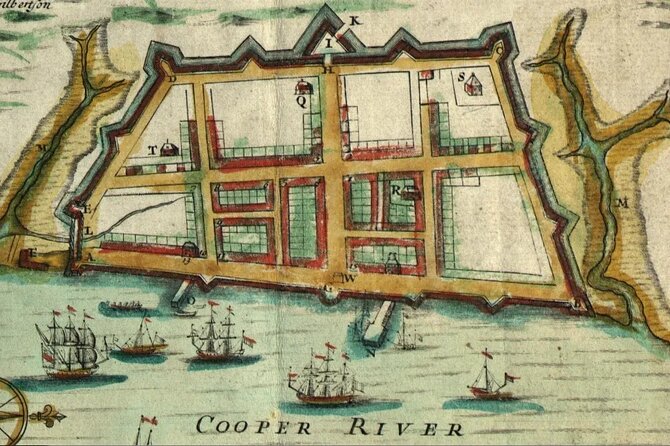
This is the kind of walking tour I think works best early in your trip. You come in with the usual postcard version of Charleston, then you leave with a sharper sense of how the city changed over time, and why certain streets, churches, and civic buildings matter.
At $40 per person for about 3 hours, the value comes from two things. First, many stops are free to view, so you are not paying again and again just to stand in front of a door. Second, the guide is a real academic, Eric Lager, Ph.D., who is used to explaining history clearly to different types of people.
A helpful detail for planning: the tour uses a mobile ticket, is offered in English, and it is capped at 12 travelers maximum. That smaller size is not just a comfort perk. It changes how the talk lands. You are not fighting for audio while the guide talks to a crowd.
More Historical Tours in Charleston
- Charleston’s Old South Carriage Historic Horse & Carriage Tour
★ 5.0 · 10,023 reviews - Historic Charleston Guided Sightseeing Walking Tour
★ 5.0 · 6,216 reviews - Charleston Horse-Drawn Carriage Tour: Explore Historic Charleston
★ 5.0 · 3,561 reviews
Why the small group matters (especially in historic Charleston)
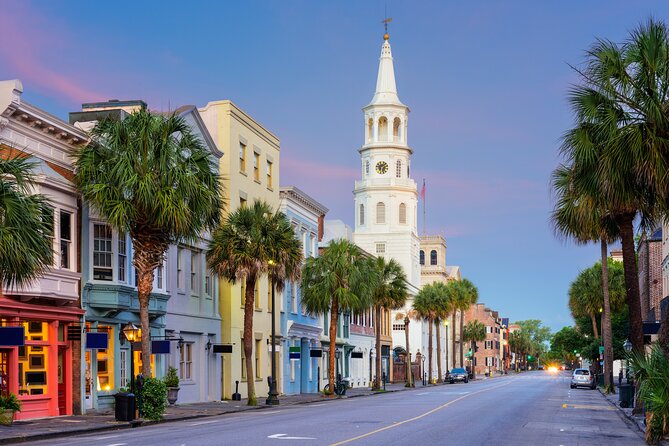
Charleston’s downtown is full of narrow streets, tight corners, and lively squares. In a bigger group, those details turn into a bottleneck. In a group of 12 or fewer, the guide can slow down, ask a question, and actually hear what you are asking before moving on.
In practice, that is what makes this tour feel like a history class without the stuffiness. People can raise their hand, and the answers connect back to what you are standing near: churches, theaters, civic buildings, and the civic and political storylines they represent.
If you are the type who likes to get your bearings fast, this format is ideal. It also helps if you are traveling with friends who might not all want the same level of detail. The tour has enough structure to keep you moving, and enough flexibility for questions to shape the conversation.
Where you start, where you finish, and how to be ready
The walk begins at 108 Meeting St, Charleston, SC 29401 and ends at 39 E Battery, Charleston, SC 29401, near Rainbow Row. That end point is smart because you are finishing in a scenic area where you can keep strolling on your own.
The tour lasts about 3 hours, and it assumes moderate physical fitness. This is not a race, but it is real walking over multiple stops. Bring comfortable shoes, and if you are visiting in cooler weather, I suggest dressing in layers. The tour runs as long as weather is workable, and good walking days often still feel cold in the shade.
One more practical point: bottled water is not included. Charleston can be warm, and even in comfortable temperatures, you will want water on a 3-hour downtown walk.
Your walk, stop by stop: what you see and what to watch for

More Walking Tours in Charleston
- Ghosts of Charleston Night-Time Walking Tour with Unitarian Church Graveyard
★ 4.5 · 2,835 reviews - Hidden Alleyways and Historic Sites Small-Group Walking Tour
★ 5.0 · 2,335 reviews - Highlights of Charleston Guided Walking Tour
★ 5.0 · 2,206 reviews - Charleston Haunted Booze and Boos Ghost Walking Tour
★ 5.0 · 1,569 reviews
Stop 1: Mills House Charleston, Curio Collection by Hilton
You start with a building that connects Charleston’s early Civil War era to places you can still recognize today. The Mills House is treated here as more than a hotel. It is used as a doorway into how the city was drawn into the early phase of the conflict, when politics and power were shifting quickly.
Drawback to plan for: you only get a short moment at each stop, about 10 minutes here. If you like taking photos, make sure your phone battery is good, because the walk moves along fast.
Stop 2: Dock Street Theater
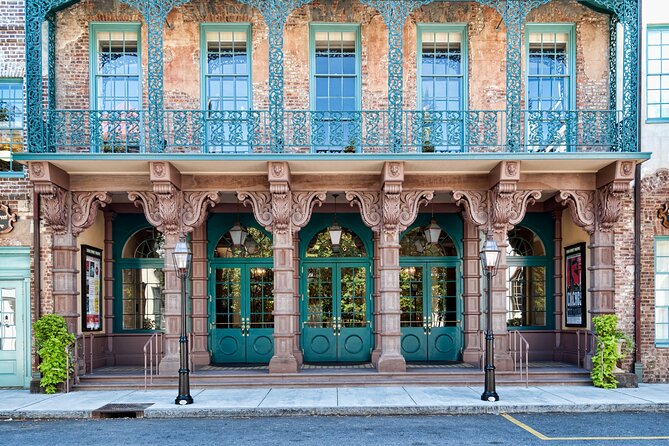
Dock Street Theater is a crowd favorite because it is linked to the claim of being the first theatre built in North America. It is also the kind of place where history gets personal, since theaters collect stories: performers, audiences, and the social world that gathers around entertainment.
Time reality: you get around 10 minutes. That is enough to set the context and understand why the theater matters, but not enough for a deep self-guided museum style visit. Think of this as a story moment, not a long indoor stop.
Stop 3: Pink House Gallery (circa 1712)
The Pink House Gallery is presented as one of the oldest buildings in Charleston, dating to around 1712. This is one of those stops that works well for people who love architectural history. It is a reminder that Charleston’s “old” is not a vibe, it is literal building age.
Watch for: if you are hoping to go inside, the focus is usually on what you can see and understand from the outside area during the short stop. Enjoy the structure and street context, then keep moving.
Stop 4: Washington Square
Washington Square is the kind of historic space that helps the tour connect people, power, and memory. It is described as a square with multiple monuments, which matters because monuments are how cities tell their own version of history.
One consideration: squares can feel busy with foot traffic. In a small group, that is manageable, but you will likely still want a quick moment to listen first, then step aside for photos.
Stop 5: Charleston City Hall
At Charleston City Hall, the story is about how civic power changes over time. The building is described as having served roles including a meat market and a bank before becoming City Hall. That transformation is a big theme in Charleston, where buildings keep shifting purpose but the city keeps the location.
Drawback: since the stop is about 10 minutes, you will get the big storyline and key ideas rather than a detailed architecture lecture.
Stop 6: Charleston County Courthouse
Next is the Charleston County Courthouse, which is used as a reference point for the old South Carolina statehouse. This is where the tour leans into the political side of history, showing how institutions of governance shaped daily life.
If you like “why this building exists here” questions, this stop tends to satisfy. If you want a quiet break, this is less of a rest stop and more of a context stop.
Stop 7: St. Michael’s Church (completed in 1761)
St. Michael’s Church is presented as Charleston’s oldest church edifice, completed in 1761. For me, the value of a stop like this is how quickly it anchors you in the colonial era. A church is not just religion in this story. It is community, permanence, and who had the power to build.
Plan for: another short 10-minute window. Take in the setting and let the guide connect it to the wider city story.
Stop 8: Heyward-Washington House
You then see the Heyward-Washington House, known here for being where George Washington stayed while visiting Charleston in 1791. That is a magnet detail, and it helps the tour connect big national events to specific addresses.
Important practical note: admission here is not included. So even though you will likely see it from the outside during the time on the walk, you should budget for a separate ticket if you want to go inside.
Stop 9: Old Exchange & Provost Dungeon
This is one of the most intense stops in the story because it ties together British-era Charleston and early American governance. You will learn that this was the last public building built by the British in North America, and that it is where the Constitution was ratified in 1788.
Another practical note: admission here is not included. If you are a history-first visitor who wants to see the inside spaces, you might want to decide ahead of time whether to plan extra time and pay the entry ticket on your own.
Stop 10: French Huguenot Church
Next comes the French Huguenot Church, used to highlight the French Huguenot story in Charleston and the church’s role as the first church built in the Gothic Revival style. This is a good pause in the overall national conflict narrative, since it brings in migration, religion, and cultural influence.
Expect this as a short stop (about 10 minutes). You will walk away knowing why the church matters, even if you do not go inside.
Stop 11: French Quarter
Then you shift from specific buildings to the feel of the neighborhood. The French Quarter is described as having beauty and charm, and that is exactly how it works in the tour. You slow down mentally and start noticing street rhythm, architecture, and how the city’s layout shapes its identity.
Because it is 15 minutes, it gives you a little more time to soak it in. This is also a great moment to ask how the neighborhood fits into the bigger “Charleston over time” storyline.
Stop 12: Hibernian Hall
Hibernian Hall is presented with two strong angles. First, it is described as the building where the seeds of disunion were sown. Second, it is connected to America’s relationship with Greek Revival architecture. That pairing is useful, because it links the look of the building to the tension building in society.
Practical note: admission here is not included. If you want the inside experience, plan extra time and a separate ticket.
Stop 13: Fort Sumter National Monument (view from the Battery)
The grand finale is Fort Sumter National Monument, tied directly to the opening shots of the Civil War. You do not go out to the fort. Instead, the tour takes a look from the Battery on Charleston Harbor.
This detail is a big deal for planning. It keeps the tour efficient, and it means you still get the Civil War connection without needing a boat or a long on-site time block. If you are hoping for an actual fort visit and museum time, this tour might not fully replace that. Think of it as a “you are here, this is the moment” viewpoint.
Is this worth $40? My value check for you
For a 3-hour walking tour, $40 is reasonable if the guide can do three things at once: tell a coherent story, keep the pace moving, and help you understand what you are looking at.
This one leans hard on value because so many stops are free to view, and because the tour is built for a small group. When you pay for a walking tour, you are usually paying for access to interpretation. Here, the interpretation is anchored by an actual Ph.D historian from The Citadel, and the talk is designed to be interactive.
It also tends to feel worth it if you like connections, not just facts. The route pulls together Revolutionary-era themes, civic history, religious buildings, and the road into Civil War conflict. You leave with a map in your head, not just photos on your phone.
One thing to factor in: a few stops have admission tickets not included (like Heyward-Washington House, Old Exchange & Provost Dungeon, Hibernian Hall, and Fort Sumter National Monument). If you want to go inside several of those, your total trip cost will rise. If you are mostly content with street-level viewing, $40 stays the main number.
Who should book this tour, and who might want something different
Book it if you:
- Want a clear historical story tied to buildings and street corners, not just a list of dates
- Like asking questions and getting explanations that go beyond the usual quick tour talk
- Prefer a small group format where you can hear the guide
You might choose something else if you:
- Hate walking and need long rests at each stop
- Want a tour that includes lots of indoor time at every major site, since this is focused on short, guided stops and viewpoints
If this is your first visit to Charleston, I think it is a strong choice because it helps you understand what you are seeing later. It also works well for couples and solo visitors, since the route is compact and easy to follow.
Should you book Charleston History Walk with Eric Lager, Ph.D.?
I would book this if your idea of a great day in Charleston includes history that feels connected to real places. This tour’s biggest strength is the combination of academic depth and small-group conversation. You cover major sites from colonial times into the Civil War era, and the end location near Rainbow Row gives you a natural next step.
If you are on the fence, do one quick check: are you excited to listen for 3 hours and walk between about a dozen stops? If yes, this is one of the better ways to get meaning out of Charleston’s old streets without paying for every indoor museum visit on top of it. If you want only sightseeing with minimal talking, you might find the pace and story density more than you bargained for.
FAQ
How long is the Charleston historical walking tour?
It runs for about 3 hours.
What is the group size limit?
The tour is capped at a maximum of 12 travelers.
Where does the tour start and where does it end?
It starts at 108 Meeting St, Charleston, SC 29401, and it ends at 39 E Battery, near Rainbow Row.
Is the tour offered in English?
Yes, it is offered in English.
Are admission tickets included for all stops?
Most stops are free to view during the walk, but several locations list admission tickets as not included, including Heyward-Washington House, Old Exchange & Provost Dungeon, Hibernian Hall, and Fort Sumter National Monument.
Will you go out to Fort Sumter during the tour?
No. You view Fort Sumter from the Battery on Charleston Harbor.
Does the price include fees and taxes?
Yes, all fees and taxes are included in the $40 price.
What if the weather is poor or I need to cancel?
The tour requires good weather. If it is canceled due to poor weather, you will be offered a different date or a full refund. You can cancel up to 24 hours in advance for a full refund; within 24 hours, the amount paid is not refunded.
Reviewed most recently around Charleston
- Real Hauntings of Charleston! (Small Group Ghost Tour)★ 5.0 · 724 reviews
- Charleston Water Taxi Cruise with Dolphin Sighting★ 5.0 · 857 reviews
- Savor the Flavors of Charleston Walking Food Tour★ 4.5 · 881 reviews
- Undiscovered Charleston: Half Day Food, Wine & History Tour with Cooking Class★ 5.0 · 948 reviews
- 2-Hour Guided Kayak Eco Tour in Charleston★ 5.0 · 954 reviews
- Charleston’s Pleasing Terrors Night-Time Walking Ghost Tour★ 5.0 · 1,345 reviews
- Downtown Charleston Food Tour★ 4.5 · 1,376 reviews
- Charleston City Sightseeing Bus Tour★ 5.0 · 1,422 reviews
Walking Tours, compared.
History and Hauntings of Salem Guided Walking Tour
Read our review →
New Orleans Premier Ghost, Voodoo and Vampire Walking Tour
Read our review →

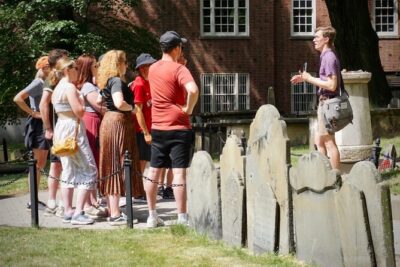
Freedom Trail History Small Group Walking Tour
Read our review →
Historic Charleston Guided Sightseeing Walking Tour
Read our review →
New Orleans Food Walking Tour of the French Quarter with Small-Group Option
Read our review →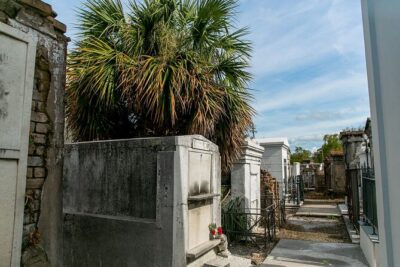
St. Louis Cemetery No. 1 Official Walking Tour
Read our review →Browse the lists this tour appears in