
Reviewed · FREEDOM TRAIL TOURS
Boston: Freedom Trail History Small Group Walking Tour
The Freedom Trail can feel like a long list of famous spots. This small-group walk makes it click by threading the American Revolution years, roughly 1760 to 1775, through the streets you actually walk. I especially like the small-group format (max 16) and the way your historian guide keeps the focus on the Revolutionary buildup instead of random facts.
One possible drawback: this is an outdoors-first walking experience. You’ll see a lot from the sidewalk and courtyards, but museum entry and inside visits aren’t part of the plan, and Charlestown is not included.
Key Points to Know Before You Go
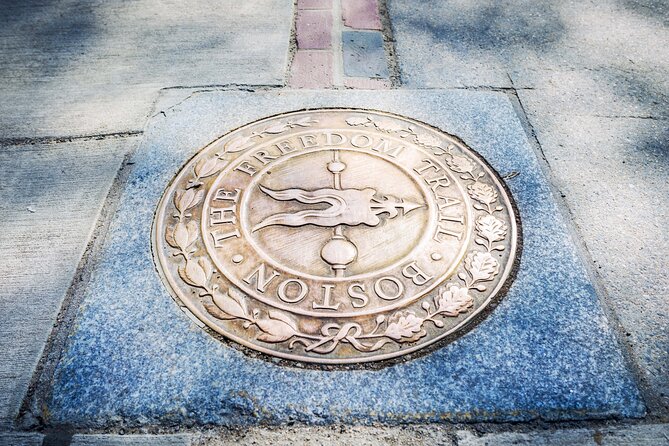
- Historian-led route focused on 1760 to 1775, not a generic “everybody knows this” recap
- All 16 official Freedom Trail landmarks covered in about 2.5 hours
- Small-group size (16 guests max) keeps questions from getting lost
- Ends at Copp’s Hill Terrace, with Charles River views to USS Constitution and Bunker Hill Monument
- Wheelchair and stroller accessible, with guidance for travelers who need to keep standing time manageable
- Winter-friendly pacing, with guides using indoor or sheltered moments when conditions are rough
The Freedom Trail Walk That Helps You See the Revolution in Context
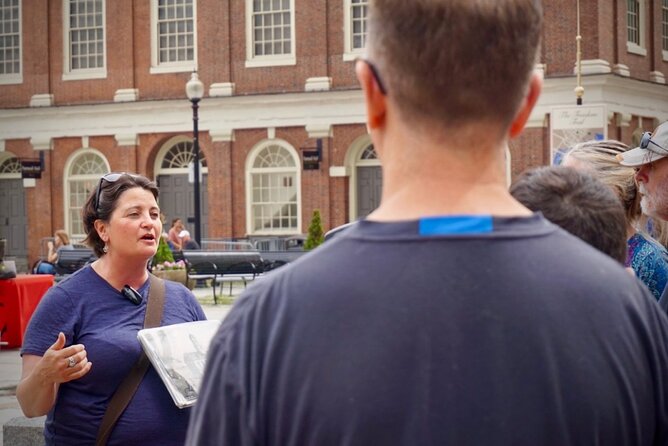
Boston’s Freedom Trail works because it’s physical. You aren’t studying a map and hoping the timeline makes sense. You’re standing at the places where people argued, printed pamphlets, met in town halls, and watched events turn ugly. That is why this tour model works so well for first-timers and history buffs alike.
What I like about the approach here is the tight time window. Your guide zooms in on the years when tension turns into action. Expect stories that connect the dots, like how political organizing and public meetings fed into the moment when violence and protest became unavoidable.
You’ll also walk through Downtown Boston and the North End, which matters. The route is built so you learn the city’s shape as you go, not just the list of sights. The end point, Copp’s Hill Terrace, gives you a payoff view across the water, tying the story to the battles beyond Boston’s streets.
More Historical Tours in Boston
- Tour of Historic Fenway Park, America’s Most Beloved Ballpark
★ 4.5 · 3,013 reviews - Boston Food & History: Pizza, North End & Freedom Trail
★ 5.0 · 1,772 reviews - Boston: City Cruises Historical Sightseeing Cruise
★ 4.6 · 1,771 reviews
Price, Time, and What You Actually Get for $35.10
At about $35.10 per person for roughly 2 hours 30 minutes, the value is mainly in three things: a historian guide, a tight route that covers the main trail stops, and the small-group feel.
You’re not paying for entry tickets inside museums during the walk. The tour includes the Freedom Trail experience and focuses on the outdoor landmarks themselves. That means you get maximum mileage for your time in Boston, especially if you’re short on days.
Also, this is the kind of tour that tends to make your later self-guided walking easier. After this, you’ll recognize what you’re looking at, why it mattered, and what year it belongs to. Even if you return to a spot later, you usually end up understanding more on the second visit.
One practical note: it’s booked about 22 days in advance on average, so if you want a specific departure time, you’ll have an easier time planning ahead.
Meeting at Boston Common and Starting With the Right Mindset
You meet at the Boston Foundation Monument inside Boston Common, on the northern boundary of the park, across from 50 Beacon Street (02108). It’s an easy anchor point, which helps because you’ll want to start on time to cover all the stops without feeling rushed.
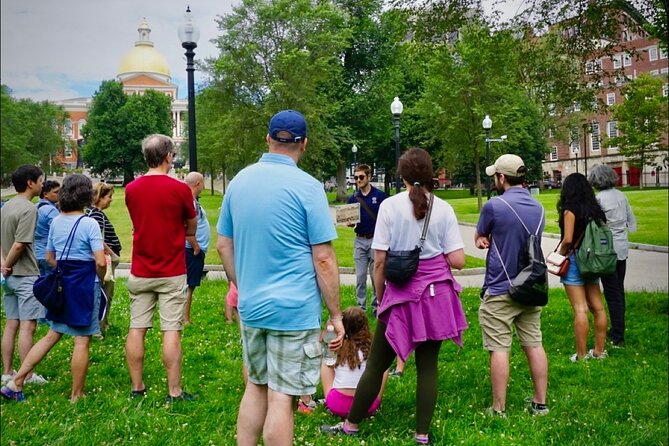
The tour begins with check-in, then your group sets off together. Since the maximum group size is 16, you can usually ask a real question when it comes up instead of shouting at the back of a crowd. Guides here are clearly used to handling Q and A during the walk, which turns the trail into a conversation.
Bring your “walking brain.” Meaning, try to notice details as you pass them. Even when you’re just seeing stone walls and building fronts, your guide’s story gives you a reason to look.
Stop-by-Stop: From Boston Common to Granary Burying Ground
More Walking Tours in Boston
- Cambridge: Harvard University Student-Guided Walking Tour
★ 4.6 · 3,931 reviews - Harvard University Campus Guided Walking Tour
★ 4.5 · 3,632 reviews - Boston Freedom Trail Walking Tour with Costumed Guide
★ 4.5 · 2,531 reviews - The Full Revolutionary Story Epic Small Group Boston Walking Tour
★ 5.0 · 2,356 reviews
Stop 1: Boston Foundation Monument, then the early-Boston context
You start at the Boston Foundation Monument. The granite memorial includes a bronze relief showing Puritans arriving in 1630, the beginning of the Boston story you’ll keep circling back to. This is where the guide helps you understand the roots of the political culture you’ll later see explode during the Revolution years.
After that, the route connects toward the Massachusetts State Capitol area, including the reference point about the Hub of the Solar System (1798). The point here isn’t that you’re touring the capitol building. It’s that you’re tracing how power and government evolved in the same general area over time.
Boston Common, the oldest communal space
Next comes Boston Common, described as the oldest public land in the Americas and used as Boston’s communal grazing pasture (1634). Standing here, it helps to think of it as “the shared public stage.” In a city like Boston, big arguments and big events often spill into public spaces.
A church with skyline reach
You’ll also pause for the stop described as an active church and the tallest building in 19th-century Boston (1809). This is one of those “look up and notice” moments. When your guide points out what was tall then, it helps you visualize how the city’s physical hierarchy shifted over time.
Stop 3: Granary Burying Ground, where Revolutionary figures are anchored
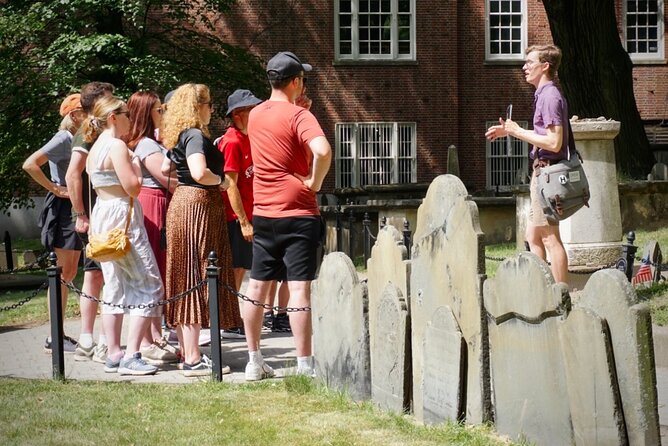
Then you reach Granary Burying Ground, Boston’s third-oldest burying ground, and a final resting place for Revolutionary Boston (1660). This stop works because it makes the people feel real. You’re not just hearing about 1770s politics in the abstract.
You’ll also hear connections linked to the nearby historic burial grounds and church origins mentioned along the way, like the first Church of England in Puritan Boston (1686, 1754) and the oldest burying ground in Boston (1630). These details help you understand how early settlers built institutions, then kept rebuilding them as the colony changed.
Main drawback at these early stops: you’re outside, and Boston weather can cut into comfort quickly. If it’s cold, bring gloves and a hat. If it’s bright, bring sunglasses too. The tour is only about 2.5 hours, so you won’t want to spend it fidgeting.
Benjamin Franklin, Boston Latin School, and the Road Toward 1773
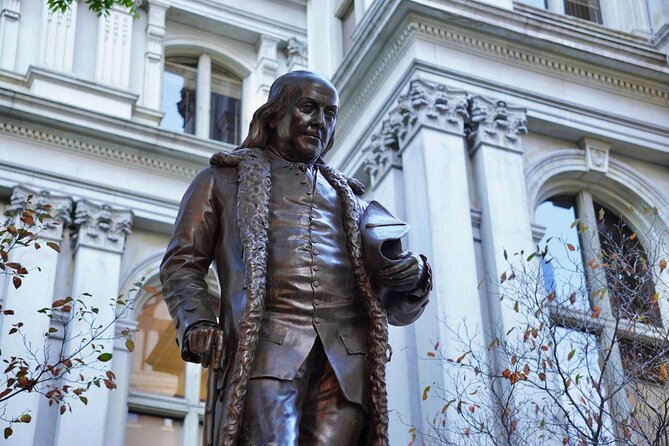
Stop 4: The Statue of Benjamin Franklin as a learning hub
The walk continues to the Statue of Benjamin Franklin. This isn’t only a statue stop. The story points you toward educational and civic milestones tied to Franklin’s era, including the mention of Boston Latin School (1635) as the oldest public school in the Americas.
From there, the route keeps pulling you forward through politics and public institutions. Expect pauses that connect to the publishing world too, including the former publishing house of Ticknor & Fields (1718), and congregational meeting spaces, such as the meeting house described in the route.
The most important “why this stop matters” moment is the reference to the origin site of the Boston Tea Party (1773) tied to a congregationalist meeting house (1729). When you stand in that part of town and hear what happened nearby, the Revolution stops sounding like distant textbook chapters. It becomes street-level cause and effect.
The Boston Massacre Site and Faneuil Hall’s Political Pressure Cooker
Stop 5: Boston Massacre Site, 1770 in plain sight
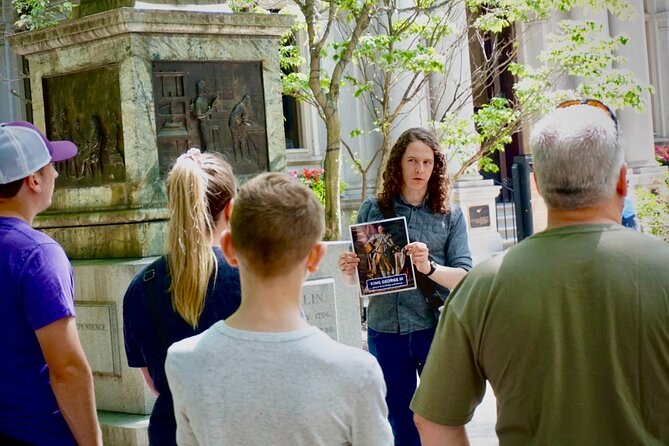
At the Boston Massacre Site, you hear the core event: British soldiers kill five Bostonians (1770). What I find useful here is that your guide likely frames it as a turning point, not just a tragedy you’re supposed to memorize.
This is also where your guide’s timeline focus shows. The Revolution doesn’t happen in one day. Events like this build fear, anger, and organizing energy. That’s the logic your guide is trying to make you feel as you move to the next spot.
Stop 6: Faneuil Hall Marketplace, the Cradle of Liberty
Then it’s Faneuil Hall Marketplace, described as the host of Boston town meetings and known today as The Cradle of Liberty (1742). This is one of the biggest “aha” moments for many first-timers. Town meetings were not just quaint civic theater. They were the mechanism people used to argue, persuade, and coordinate.
You’ll also hear the fun bonus detail at Faneuil Hall: the oldest restaurant in the United States (1826) located in a historic building from 1704. Even if you don’t stop for a meal right then, it’s a neat reminder that historic buildings kept finding new roles after the Revolutionary era.
North Square Park to Paul Revere Statue: The North End in Action
Stop 7: North Square Park
Next you get North Square Park, described as a historic public square in the heart of Boston’s North End (1634). Squares like this were social and political pressure points. Your guide uses that context to make the area feel purposeful, not just scenic.
Paul Revere House connection
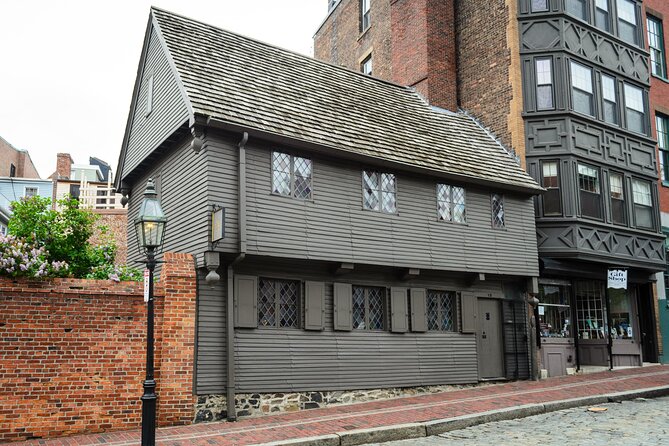
At this stage, the route also references the home of Paul Revere and the oldest structure in Downtown Boston (1680). This stop is great if you want a human face for the Revolution. Revere’s story can feel over-told if you only know the legend. A good guide ties it back to networks, communication, and urgency.
Stop 8: Paul Revere Statue, and the signals at Old North
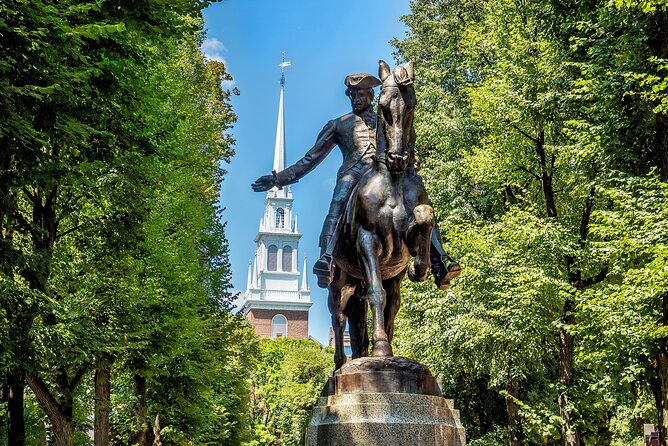
You pause at the Paul Revere Statue in a pedestrian-only space honoring the Midnight Ride (1775). The guide then connects it to the nearby point about Boston’s oldest church held signal lanterns during the Midnight Ride of Paul Revere (1723). That detail matters because it’s one of the most “how did they do this so fast?” moments of the story.
You’ll also see references along the route to burial grounds, including the second-oldest burying ground in Boston (1659). It’s a reminder that the North End isn’t only about dramatic rides. It’s also about long community memory.
Copp’s Hill Terrace: Where the Story Ends With a Real View
The tour concludes at Copps Hill Terrace, with about 20 minutes for the finale. You’re overlooking the Charles River, plus two major landmarks across the water: the USS Constitution (1797) and the Bunker Hill Monument (1775 battle).
This end point is more than a photo moment. It gives you scale. Boston isn’t just a set of blocks. It’s a harbor city connected to military events that extend out of sight. When your guide ties the streets you walked to what those landmarks represent, the Revolution feels like one connected geography.
After the tour, Copp’s Hill Terrace is steps from Hanover Street, where you’ll find Italian restaurants, pastry shops, and pizza. If you want a low-key win, eat close by while your guide’s timeline is still fresh in your head.
The Guides Make or Break It, and Here the Stories Tend to Land
This tour’s reputation is largely about guide performance, and you can feel that in the pattern of what people praise.
Guides like Jon are described as walking the story chronologically, with the final moments turning emotional in a way that sticks. Others, like Alejandro, are noted for handling freezing weather by taking chances to share information indoors when possible, instead of just forcing the group to suffer. Cyrus gets credit for making the tour enjoyable even in bitter conditions.
You’ll also see repeat praise for guides like Mark and Cal for making details clear and answering questions with real flow. Names that came up include Kiera, Maura, Maz, Will, Miles, Amelia, and Nick too, which tells me this is not a one-guide show. The common thread is storytelling, pacing, and comfort.
One thing I recommend you do during the walk: ask one question that goes beyond the site in front of you. For example, ask how people organized around public meetings, or why certain locations mattered politically. With a group of up to 16, you’re more likely to get an actual answer instead of a rushed one.
Walking Comfort, Accessibility, and Cold-Weather Reality
Good news first: the tour is wheelchair and stroller accessible, and service animals are allowed. You’re also near public transportation, so if you need to shorten your day, you can usually adjust plans.
The watch-out is standing time. The tour works best if you have moderate physical fitness, and it is not recommended for travelers who have difficulty standing for extended periods. Plan for a steady pace with stops, not a slow museum-style shuffle.
In winter, expect wind. Multiple guides are praised for trying to keep people warm, including by using indoor or sheltered spots when available. Still, your layers matter. Bring a warm hat, water-resistant outerwear, and something for your hands. If it’s freezing, the tour can feel long even when the information is excellent.
Who This Tour Suits Best, and Who Might Skip It
This is a strong fit if:
- You’re a first-time Boston visitor who wants a fast, structured way to understand the Revolution
- You like history that connects dates to places, not just facts in a vacuum
- You want a manageable walk that still covers all 16 official Freedom Trail landmarks
- You enjoy asking questions and getting answers in context
You may want a different plan if:
- You want lots of inside museum time during the tour
- You specifically want Charlestown included, because this route focuses on Downtown Boston and the North End
- You’re traveling with limited tolerance for standing outside for the full route
Should You Book This Freedom Trail Walk? My Take
Yes, I’d book it, especially if this is your first day in Boston or your first look at the Freedom Trail. The price is reasonable for what you get: a historian-driven timeline, small-group attention, and a complete walk of the trail’s main official landmarks in about 2.5 hours.
I’d also treat it like a foundation. You’ll likely return to one or two places after the tour, because you’ll know what to look for and what questions to ask when you’re on your own.
If you can handle cold weather or plan to dress for it, this is one of the easiest ways to turn Boston’s Revolution era from memorizing names into understanding how the city moved toward change.
FAQ
How long is the Boston Freedom Trail History small-group walking tour?
It runs for about 2 hours 30 minutes.
Where do I meet the guide for the tour?
You meet at the Boston Foundation Monument inside Boston Common, on the northern boundary of the park, opposite 50 Beacon Street (02108).
Where does the tour end?
The tour ends at Copps Hill Terrace (520 Commercial St, Boston, MA 02109).
Does the tour include all Freedom Trail landmarks?
Yes. It includes the 16 official historic landmarks on the Freedom Trail.
Is the tour wheelchair and stroller accessible?
Yes, the experience is wheelchair and stroller accessible.
Are museum admissions included during the tour?
Museum admissions are not included, and the tour is focused on the Freedom Trail stops outside.
Is Charlestown included in this tour?
No. Charlestown neighborhood is not included.
Is the tour operated in any weather?
The tour requires good weather. If it’s canceled due to poor weather, you will be offered a different date or a full refund.
What is the cancellation refund window?
Free cancellation is available up to 24 hours in advance for a full refund. If you cancel less than 24 hours before the experience start time, the amount you paid will not be refunded.
How big is the group?
The tour has a maximum of 16 travelers.
More of the Freedom Trail
- Boston’s Freedom Trail: A Revolutionary Walking Tour
★ 4.9 · 1,748 reviews - Boston’s Freedom Trail: A Revolutionary Walking Tour
★ 5.0 · 1,343 reviews - Freedom Trail Walking Tour 250
★ 4.5 · 1,118 reviews - Boston Freedom Trail History Pub Crawl Small-Group Tour
★ 5.0 · 996 reviews
Reviewed most recently around Boston
- City Cruises Salem High Speed Ferry to/from Boston★ 4.5 · 727 reviews
- Entire Freedom Trail Walking Tour: Includes Bunker Hill and USS Constitution★ 5.0 · 732 reviews
- Boston Freedom Trail History Pub Crawl Small-Group Tour★ 5.0 · 996 reviews
- Delicious Donuts of Boston: A Sweet History Walking Tour★ 5.0 · 1,038 reviews
- Boston Pizza Lovers Food and History Walking Food Tour★ 4.5 · 1,082 reviews
- Freedom Trail Walking Tour 250★ 4.5 · 1,118 reviews
- Boston’s North End Food Tour: Italian Flavors & Heritage Walk★ 5.0 · 1,322 reviews
- Boston’s Freedom Trail: A Revolutionary Walking Tour★ 5.0 · 1,343 reviews
Freedom Trail Tours, compared.
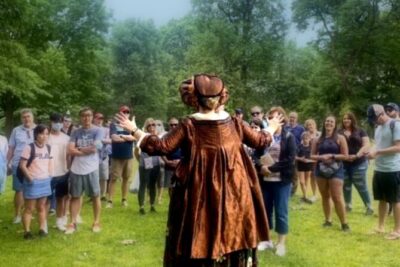
Boston Freedom Trail Walking Tour with Costumed Guide
Read our review →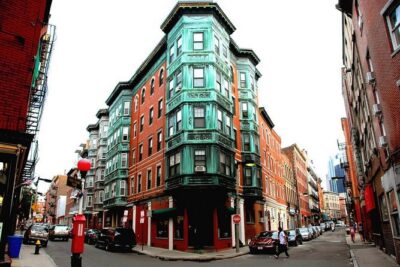
Boston Food & History: Pizza, North End & Freedom Trail
Read our review →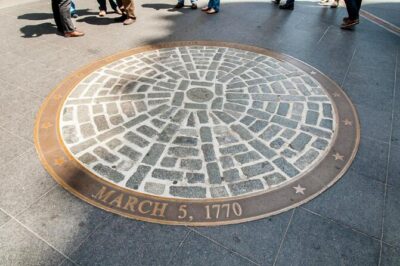
Boston’s Freedom Trail: A Revolutionary Walking Tour
Read our review →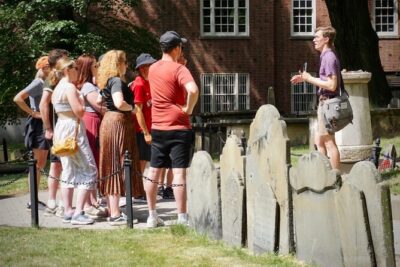
Freedom Trail History Small Group Walking Tour
Read our review →

Boston Freedom Trail History Pub Crawl Small-Group Tour
Read our review →
Entire Freedom Trail Walking Tour: Includes Bunker Hill and USS Constitution
Read our review →Browse the lists this tour appears in