
Reviewed · HISTORICAL TOURS
Revolution and the Founders: History Tour of Philadelphia
Philadelphia’s Revolution-and-founders story is interesting in a very practical way, because the key places are close enough to do them on foot. In a tight two hours, you get a guided route through the symbols and decision points that shaped America, plus a side of early Philadelphia life that many first-time visits miss. It’s not just sightseeing, it’s a guided walk through how the country got invented.
What I like most is the way the guide teaches, with a degree in history and a knack for making the timeline feel clear. Second, I love the pacing, because the tour is fast enough to keep you moving, but not so rushed that the big moments feel vague. The possible drawback is that you are outside a lot and major building access can be limited, so you will want to dress for cold or rain and plan around any timed-entry needs.
If you’re the kind of traveler who likes stories with names, dates, and real locations, this is an efficient way to get your bearings in Old City. Just know that you may not be going deep into every interior space, and you might see some sites mostly from the outside.
Quick reasons this tour works so well
- History-degree guides who can explain how the Revolution actually played out in Philadelphia
- A tight 2-hour walk that hits the must-sees without eating your whole day
- Freedom-and-democracy landmarks like Liberty Bell, Independence Hall, and the early government buildings
- Franklin-focused stops that connect science, communication, and politics in one route
- A small group cap of 24 which helps keep questions from piling up
- Morning and afternoon departures, rain or shine, so you can fit it around the rest of your trip
A 2-hour walk through Philadelphia’s founding story
This is built for people who want the essentials fast, without turning the day into a checklist. You start in the Historic Old City area, then walk your way through the Revolution era and the early leadership that made Philadelphia the center of the new nation.
What makes it especially worth it is how the stops connect to each other. You are not only visiting big icons like the Liberty Bell and Independence Hall. You also hear how government, money, communication, and even scientific experiments all fed into independence and nation-building.
More Historical Tours in Philadelphia:
- Philadelphia Old City Historic Walking Tour with 10+ Top Sites
★ 5.0 · 2,020 reviews - 2.5 Hour Philadelphia History Tour with Washington War Tent Show
★ 5.0 · 924 reviews - New York City: American Museum of Natural History Ticket
★ 4.5 · 15,447 reviews
Your guide, the small-group feel, and why names keep popping up
The tour is run by Grim Philly Twilight Tours, and a standout detail is that every guide has a history degree. The guides you may meet are often history teachers or American history professors, and they bring that classroom clarity into a walking format.
In the feedback, certain guides show up again and again by name, including Josh, Kyle, Ted, Joseph, and Vince. What you’re likely to get with strong guides is story flow that feels almost theatrical. Some guides add acting-style moments and interactive questions, which can make the time fly. One note of caution from the same kind of feedback: if you personally prefer pure lecture style with less performance, you might want to manage expectations about dramatic storytelling.
The group size caps at 24 travelers, and that matters more than you’d think. Smaller groups usually mean easier interaction and fewer times where you only hear the guide from the back of the pack.
Meeting point, route flow, and what to wear for a rain-or-shine walk
Your tour start is at Grim Philly Twilight Tours, 523 Market St, Philadelphia, PA 19106. The tour ends at the Merchant Exchange Building, 143 S 3rd St, Philadelphia, PA 19106, finishing just behind City Tavern and Merchants Exchange, where the Continental Congress met every Saturday.
Logistically, this is helpful because it drops you in the same Old City zone, so you can keep exploring right after the tour. It is also convenient that the tour runs every morning and every afternoon rain or shine, so you have options if one part of your day turns out gray.
Practical travel advice: plan for standing and walking. Even when the guide is moving fast, there are moments where you will stop to listen and look. If weather is cold, bundle up. If it’s raining, wear shoes you trust on wet sidewalks.
Liberty Bell pavilion exterior, and the timing choice that matters
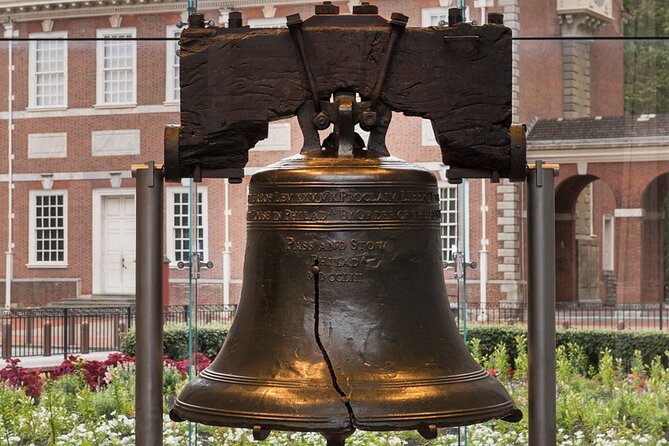
One of the first stops is the Liberty Bell area in the National Historic Park. This is the moment most people come for, and it can be a zoo in peak season. The tour keeps you moving, and you learn the bell’s creation story and why it became a symbol of liberty.
You get key context starting from the exterior of the Liberty Bell pavilion. Your guide also gives clear directions for the interior if you want to add time later, because the line can take close to an hour when things are busy. Translation: the tour itself is structured for time, but you can still choose to invest more if you want the full experience.
A specific detail you will hear here is the lettering about proclaiming liberty, tied to a Biblical reference about jubilee. That connection helps explain why the phrase stuck in the public imagination and why the bell reads like a moral argument, not just a bell.
Stack these Philadelphia options against each other
- Dark Philly Adult Night Tour
★ 5.0 · 4,241 reviews - Philadelphia Hop-On Hop-Off City Tour
★ 4.0 · 2,347 reviews - The Constitutional Walking Tour of Philadelphia
★ 4.5 · 902 reviews - Philadelphia: Eastern State Penitentiary Admission
★ 4.7 · 894 reviews
Independence Hall, timed entry reality, and how you still get value

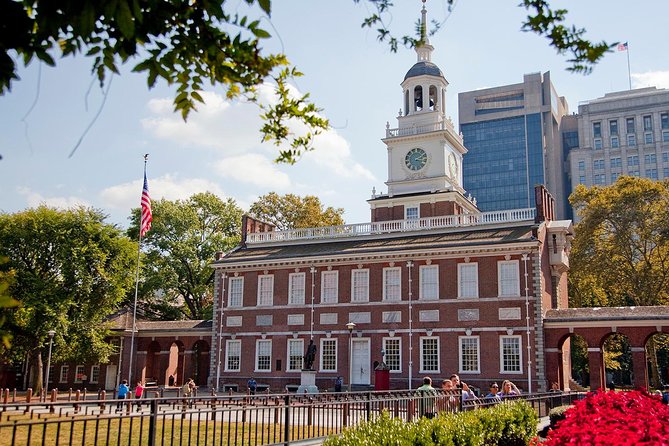
Next up is Independence Hall, where the Declaration of Independence and the Constitution were debated and adopted. This stop is the heart of the whole trip, but it comes with the reality that the complex requires free timed entry passes.
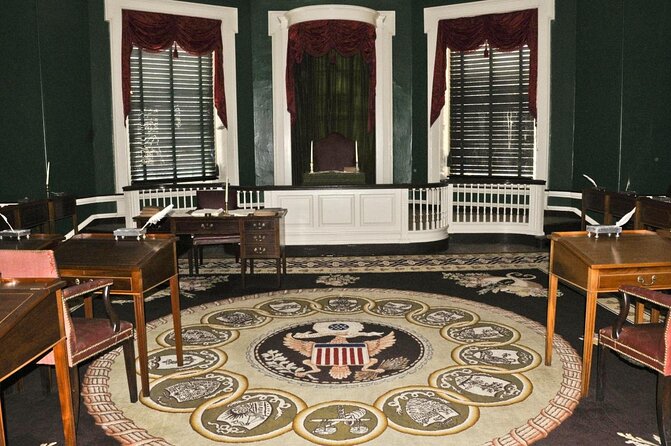
Here is the practical part. The tour is designed to keep you moving quickly so you get the most important highlights in your two-hour window. You will get a pit stop inside the East Wing, described as the oldest part of the structure that served as Supreme Court chambers when Philadelphia was the nation’s capital.
You will not be using your time to wander freely at your own pace inside the entire complex. Your guide will also explain how to continue the route on your return, if you come back later with more time. The tour does you a big favor by giving you a focused starter map, especially if you are seeing Independence Hall for the first time.
If you want a deeper interior experience, the guided stop gives you the foundation, but you should plan on additional time beyond the tour. The complex itself is set up for you to explore slowly, and the tour is not trying to replace that.
Washington’s city presidency stops, Congress Hall, and the early government maze
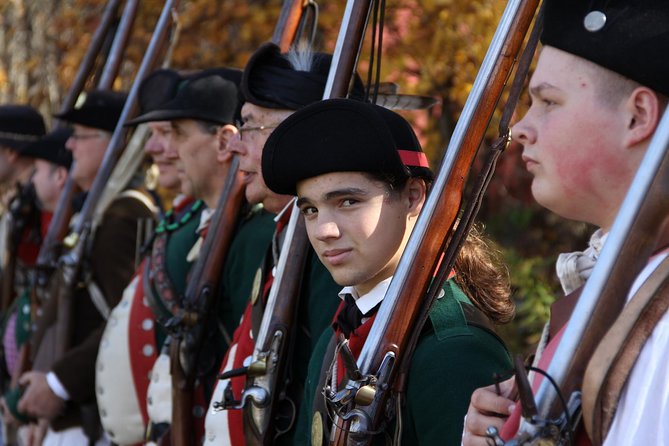
After Independence Hall, you shift from the symbolic documents to the people who ran the country in real time.
You will visit the President’s House, Philadelphia’s version of the White House during the years when Philadelphia served as capital from 1790 to 1800. Your guide will connect the building to George Washington and John Adams, and you’ll also hear about how foreign dignitaries and members of Congress and Senate came through for official and unofficial business.
This is also where the story adds extra texture. You will hear that Benedict Arnold lived there as military governor after the British evacuation of Philadelphia. Even if you already know the name, it hits differently when you are standing near a place where his story intersected with the new government.
Then comes Congress Hall, which hosted presidential inaugurations for Washington and Adams, and served as home of the U.S. Congress from 1790 to 1800. This stop helps you see the Revolution transition into governance. The tone changes from fighting for rights to building processes for making decisions.
Franklin Court and the places where ideas turned into power
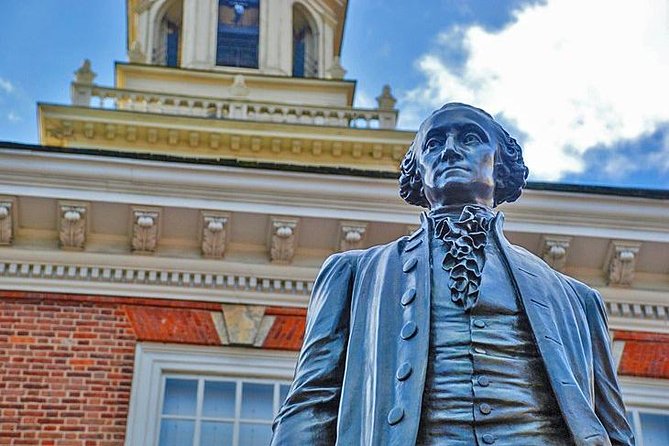
The tour does something smart by giving Benjamin Franklin more than one stop. You visit Franklin Court, described as a complex of museums, structures, and historic sites within the Independence National Historical Park. It is presented as home to Franklin during the Constitutional Convention era, and your guide ties in his ideas as a practical force behind political change.
A quote often gets used in the teaching here, about unity under pressure. Even if you remember Franklin as the scientist or the printer, this stop works because it links his thinking to how revolution becomes a shared project.
From there, you get a surprising military-adjacent stop. You will hear about the location of America’s first Pentagon, where strategy and intelligence were formulated during the American Revolution. Whether you love military history or not, this is a useful reminder that the Revolution was not only speeches and slogans. It was also planning, information, and coordination.
Benjamin Franklin Post Office and Museum: communication as a revolutionary tool

Next is the Benjamin Franklin Post Office & Museum, described as the only Colonial-themed post office operated by the U.S. Postal Service. This stop is hands-on in a way a lot of walking tours cannot manage.
Two standout details you can expect to hear:
- It is the only active post office in the U.S. that does not fly the American flag because the flag system was not in place yet in 1775 when Franklin was appointed Postmaster General.
- The postmark B. Free Franklin is still used to cancel stamps.
On top of that, there is a museum element with displays of postal history and memorabilia. Even if you skim, the basic point lands: communication networks mattered. Independence wasn’t only about breaking chains. It was also about building the practical infrastructure for a new society.
Carpenters’ Hall and the secret negotiations that tipped the odds
You then visit Carpenters’ Hall, tied to the First Continental Congress in 1774. The story here moves into the behind-the-scenes world of diplomacy and alliance-building.
Your guide shares details about secret meetings in December 1775 involving Franklin meeting with John Jay, Francis Daymon, and a French spy named Julien Achard de Bonvouloir. The point the tour emphasizes is that French support was likely necessary for winning the war.
After that, the building’s later role comes in, with the note that British forces occupied this building over the winter of 1777. That whiplash from revolutionary planning to occupation is one of the best ways to understand how unstable the city’s fate was.
The banks, Hamilton and Jackson, and how money got political
The route continues into economic power. You will see the First Bank of the United States, championed by Alexander Hamilton, founded in 1797, and noted here for its architectural design.
Then you will move to the Second Bank of the United States, chartered by President James Madison in 1816 and described as losing its charter under Andrew Jackson in 1834. Your guide discusses Hamilton and Jackson, including famous duels fought by both men, and you’ll also hear how those personalities shaped policy.
Even if you do not care about finance, this stop helps you understand that the early U.S. was building systems fast. Banks were not abstract ideas, they were tools for stability, credibility, and control.
Philosophical Society, the Library Company, and the idea of public learning
You will also pass by the American Philosophical Society, founded in 1743 by Benjamin Franklin two years after the University of Pennsylvania. The early member list includes a parade of founding-era names such as Washington, Adams, Jefferson, Hamilton, Paine, and Madison, plus other figures tied to medicine and science.
Right nearby, you will hear about the surgical center adjacent to the structure, and how these institutions sat at the edge of public change. The tour frames them as part of the same ecosystem that produced revolutionary thinking, not separate from it.
Then there is the Library Company, founded in 1731 by Franklin. The tour presents it as the first institution in the world to lend materials to the public. It’s an arresting detail because it turns Franklin from a one-dimensional famous face into a builder of access.
Dolley Madison’s house: what everyday life looked like during nation-building
The final set of stops includes a residential look at the people in power. You will visit the home of Dolley Madison, where she lived with her first husband John Todd from 1791 to 1793. The site is described as built in 1775 and as reflecting the lifestyle of the middle class in 18th century Philadelphia.
This matters because it softens the heavy political focus. You finish the tour with a reminder that leaders lived somewhere, ate somewhere, and navigated everyday life while the nation was being argued into existence.
Price and value for a first-time Philadelphia plan
At $29 per person for an approximate 2-hour guided walk, this is strong value for a few reasons.
First, you are paying for the guide’s expertise and structure, not for museum entry time. The tour gives you a clear route through the city’s core founding landmarks in a short window, which is exactly what many first-timers need.
Second, you also get a built-in advantage for future planning. Once you know the layout and the key connections, you can decide what to revisit. Several guides cover the sites in a way that makes it easier to choose which interiors to prioritize on your own after the tour.
Third, the tour includes the big outdoor framing moments, and then leaves room for you to add interiors where you want. Independence Hall requires free timed entry passes, and the Liberty Bell pavilion interior is presented as optional with added time. That setup is a practical tradeoff, and at this price point, it’s a fair one.
The main value tradeoff is that some of the most famous interiors are timed, controlled, or simply not part of the fast-moving group format. If you strongly prefer guided entry into every major building, you might want to plan extra time for that after the walk.
Who should book this, and who should choose a different option
This tour is best for you if you want:
- A smart, efficient introduction to Revolutionary Philadelphia
- A guide who can connect locations to the timeline, not just list landmarks
- A walking format that keeps you active and helps you orient yourself quickly
It can be a weaker match if you:
- Want long, slow interior time inside major buildings during the tour itself
- Hate cold weather walking, since it runs rain or shine and still involves standing and listening outdoors
- Prefer a strictly lecture style with minimal performance
Should you book Revolution and the Founders: History Tour of Philadelphia?
Yes, if your goal is to understand the Revolution through the geography of Old City in just a couple of hours. For $29, you are getting a focused route, a history-degree guide, and a story thread that connects documents, government buildings, Franklin’s influence, and the early institutions that made the new nation work.
Book it early in your trip if possible. Then you can use the tour as your base layer, deciding later which interiors or related stops deserve extra time. If you show up dressed for the weather and with a realistic plan for timed entry at Independence Hall, you will likely leave with a much clearer sense of how Philadelphia became the birthplace of independence.
FAQ
How long is the walking tour?
It runs about 2 hours (approx.).
What does it cost?
The price is $29.00 per person.
Where does the tour start and end?
It starts at Grim Philly Twilight Tours, 523 Market St, Philadelphia, PA 19106. It ends at the Merchant Exchange Building, 143 S 3rd St, Philadelphia, PA 19106, near City Tavern and Merchants Exchange.
Is this tour walking only?
Yes. It is described as a walking tour through Philadelphia, with stops at major historic sites.
Do I need timed entry for Independence Hall?
Yes. Independence Hall requires free timed entry passes, and the tour notes you will need to plan for that timed entry.
Is Liberty Bell pavilion interior access included?
The tour focuses on the Liberty Bell area from the exterior of the Liberty Bell pavilion, with instructions provided if you want to invest additional time to enter the interior.
Does the tour run in bad weather?
It runs rain or shine. If poor weather causes cancellation, you will be offered a different date or a full refund.
Is it family-friendly?
Children must be accompanied by an adult, and most travelers can participate. Service animals are allowed.
Reviewed most recently around Philadelphia
- Center City Philadelphia Food Tour with Reading Market★ 5.0 · 861 reviews
- Philadelphia: Double-Decker Hop-on Hop-off Sightseeing Tour★ 4.4 · 868 reviews
- Philadelphia: Eastern State Penitentiary Admission★ 4.7 · 894 reviews
- The Constitutional Walking Tour of Philadelphia★ 4.5 · 902 reviews
- 2.5 Hour Philadelphia History Tour with Washington War Tent Show★ 5.0 · 924 reviews
- Philadelphia Hop-On Hop-Off City Tour★ 4.0 · 2,347 reviews
- Dark Philly Adult Night Tour★ 5.0 · 4,241 reviews
- Philadelphia Old City Historic Walking Tour with 10+ Top Sites★ 5.0 · 2,020 reviews
Historical Tours, compared.
History and Hauntings of Salem Guided Walking Tour
Read our review →
Charleston’s Old South Carriage Historic Horse & Carriage Tour
Read our review →

Big Island in a Day: Volcanoes Waterfalls Sightseeing and History
Read our review →
Freedom Trail History Small Group Walking Tour
Read our review →
Historic Charleston Guided Sightseeing Walking Tour
Read our review →
Starship Landmark 90 Minute Sightseeing Cruise
Read our review →Browse the lists this tour appears in