
Reviewed · TROLLEY TOURS
Salt Lake City Trolley Tour with 3 Theatrical Guides & Live Show
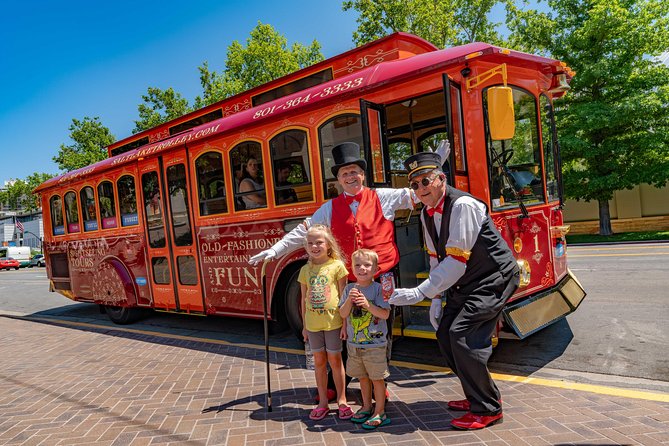
Salt Lake City can be spread out, but this trolley tour keeps things close, fast, and entertaining. The big draw is the live show on wheels: three local, theatrical guides tell the story as you roll past the places that shaped Utah, from state power to pioneer faith.
Two things I really like are the fully narrated, guided format and the way the “history lesson” turns into jokes, songs, and character work without losing the facts. A possible drawback is that many stops are brief photo stops, so if you want long, slow museum-style time in every building, you may feel rushed.
One more practical note: the tour’s cast and performers can vary. On past departures, you might hear famous guide combos like Mathew and Kelly, Anna and Matthew, Kaleigh and Max, or Shayla and Luke. Either way, the style tends to stay the same, funny plus focused, with plenty of chances to look, listen, and snap photos.
Key highlights you will notice right away

- 3 theatrical guides, one coordinated show, so the narration feels like performance, not just a lecture
- Orientation in about 2 hours, which helps you plan the rest of your Salt Lake days
- Included trolley treats, old-fashioned bottled sodas and Cracker Jacks for easy, low-key fun
- Built-in photo stops, plus a couple of longer looks so you can actually see what you are hearing
- Strong downtown concentration, especially Temple Square and early civic buildings
- A musical sightseeing show on wheels, which is the part most people talk about
Why this show-tour feels more memorable than a standard ride
Most trolley tours tell you where to look. This one tries to make you care why the place matters. The trick is that you are not just hearing a script. You are watching three guides work as a team, each taking a different angle on Salt Lake City’s story, so the tour keeps moving and your brain stays engaged.
The result is ideal for mixed groups. If you are traveling with kids, teens, or family members who get bored by long explanations, the format gives them something active to follow. If you are the history person in the group, you still get names, dates, and context, plus the sort of local storytelling that makes details stick.
My advice is to lean into the pace. This is not a slow wander through one neighborhood. It is a highlights loop where the payoff comes from seeing a lot of landmarks in a short time and then knowing what to return to later.
More Trolley Tours in Salt Lake City:
- Savannah Hop-On Hop-Off Trolley Tour
★ 4.5 · 6,527 reviews - Nashville Hop On Hop Off Trolley Tour
★ 4.5 · 5,643 reviews - Boston Hop-On Hop-Off Trolley Tour with 13 Stops
★ 4.5 · 5,576 reviews
The rhythm on board: narration, music, and how the guides keep control
The tour is designed as a live production. You have multiple entertainers and sightseeing guides working together, and that helps with pacing. When one guide is in a story, another can add a different tone, and then the whole group shifts again when you reach a new landmark.
From what I’ve seen described in real experiences, the guides tend to balance humor with accuracy. Expect comedic timing, character-style bits, and songs threaded into the route. People often mention how easy it was to remember the stories because they were performed instead of just read.
You can also plan on the small comforts being part of the experience. Several riders specifically call out good snacks and air conditioning, which matters in Utah summers when you want the ride to be pleasant, not a sweaty wait for the next stop.
Utah State Capitol and Capitol Hill: where views do half the work
One of the first big wow moments is the Utah State Capitol. The building sits high above the city, finished in 1916, with a gleaming dome and marble interiors that feel grand even if you are not a serious architecture person. Outside, the terrace views give you the valley layout and the line of the Wasatch Mountains, which makes the whole city feel more understandable.
Inside, the guides shift into story mode, connecting the physical space to political ambition, statehood, and the long push for national recognition. You also get to take in sculptures, murals, and the grand chambers where government history keeps unfolding.
Practical tip: bring your phone camera and your “quick sketch” mindset. You may have limited time, so take a couple of wide shots first, then slow down for details once you have your angles.
Cathedral of the Madeleine: Gothic Revival inside the West
Next up is the Cathedral of the Madeleine. This is a Gothic Revival standout with soaring arches, carved stone columns, and stained glass that changes the feel of the interior as you move. Completed in 1909, it was built by Catholic pioneers, and that frontier-to-European-style contrast is part of what makes it hit.
The guides usually connect faith, perseverance, and art. You will hear how a frontier congregation created a sanctuary with the scale and decoration you might expect in older parts of Europe. Even if you are not religious, the craftsmanship is the point.
A heads-up: construction can affect what you see. If you arrive during ongoing work, visibility from certain angles might be limited. The stop is still worth it for the interior and the vibe, but your photos might not be perfect.
Stack these Salt Lake City options against each other
- From Miami: Everglades Airboat, Wildlife Show & Bus Transfer
★ 4.2 · 8,622 reviews
The Mormon Battalion Monument: a long march you can actually picture
Then you roll past the Mormon Battalion Monument on Capitol Hill. The story here is dramatic on its own: 500 pioneers marching nearly 2,000 miles from Iowa toward California during the Mexican-American War. The long-distance nature of it makes it easy to remember once someone brings it to life.
What the guides tend to do well is translate distance into images: grit, endurance, and the decision-making that turned volunteer service into a major chapter in opening the West. You are also positioned with mountain views nearby, so the setting helps the story feel less abstract.
If you like historical cause and effect, this is a strong stop. It is one of those moments where you start seeing how decisions made at the time shaped Utah’s settlement patterns afterward.
Temple Square and the Salt Lake Temple: the silhouette that runs Salt Lake
Temple Square is the spiritual heart of the city, and it is also one of the most recognizable landmarks in the American West. From the trolley, you get the full sense of the space: gates, gardens, and the center of the skyline defined by temple spires.
Your guides connect this to the city’s early planning. Brigham Young chose Temple Square in 1847 as the center of the pioneer settlement, and the narrative ties that decision to the builders who worked stone by stone. The Salt Lake Temple itself, begun in 1853 and completed about 40 years later, is a granite masterpiece with six spires and intricate carving, all created by pioneer craftsmen.
Important reality check: the temple is closed to the public, so you are mostly learning from exterior views and stories rather than touring inside. Still, the guides are good at making the construction effort human, including the sheer labor behind hauling massive stones from a canyon about 20 miles away.
Salt Lake Tabernacle and the Conference Center: sound, scale, and engineering pride
The Salt Lake Tabernacle is famous for acoustics, and the tour gives you a real reason for that reputation. Built in 1867 by Mormon pioneers, the domed roof spans 150 feet without interior pillars. That engineering detail is not just trivia. It is the reason people used to say you could hear a pin drop across the hall.
The guides bring in the human side too, including the tradition of music and how performance still connects modern visitors to pioneer ingenuity. If you have ever wondered why this place became a major musical landmark, this stop answers it with facts that feel connected to the room itself.
Then you look at the Conference Center of the Church of Jesus Christ of Latter-day Saints, completed in 2000. The scale is hard to ignore: 21,000 seats, with a living rooftop garden and waterfalls. What makes it interesting on a short tour is how the guides connect technology and tradition, especially for voice carrying and gathering spaces.
If you are the type who loves “how did they build that?” questions, you will enjoy these stops back-to-back.
City and County Building, Council Hall, and other government landmarks
Salt Lake has a strong civic story, and the trolley route leans into it. The City and County Building is a sandstone castle-like landmark completed in 1894. You will see statues such as Columbia and Justice, plus a clock tower and dramatic exterior details. The guides often highlight the contrast in symbolism between civic power and religious power nearby, which makes the downtown arrangement feel like intentional design.
You also catch Council Hall, Utah’s first territorial capitol. It is Greek Revival style, built in 1866, and it gets treated like a stage for major debates in early territorial life, including arguments tied to polygamy and women’s suffrage. One of the cool facts here is that the building was moved brick by brick to Capitol Hill in the 1960s to save it from demolition.
Then there are additional landmark sightings that keep the “how power shaped the city” theme going. You will pass by the Governor’s Mansion, built in 1902 for a mining magnate, and the Joseph Smith Memorial Building, originally the Hotel Utah from 1911, known for hosting presidents, movie stars, and dignitaries while it served downtown life.
Even if you only glance, these buildings help you understand Salt Lake as more than a single faith landmark. It is also an evolving government and business center.
Beehive House and Brigham Young landmarks: leadership made visible
If you want pioneer-era history that feels personal instead of distant, Beehive House is worth your attention. Built in 1854, it was home to Brigham Young and functions as a symbol of industry and cooperation through its honeybee carvings.
The guides tend to explain how it worked both as a family home and as a kind of executive space. That perspective makes the building feel less like a static monument and more like a window into daily operations of leadership.
Around the downtown crossings, you will also see the Brigham Young Monument and the Meridian Marker. The monument honors the leader who helped settle the Salt Lake Valley in 1847, and the Meridian Marker is tied to land surveying, the point from which Utah land surveys begin. Together, these stops connect decision-making, geography, and long-term planning.
Then you pass Eagle Gate. Originally built in 1859 as an entrance to Brigham Young’s property, it is now a bronze eagle symbol on State Street. It is one of those objects where the size and shape make the story feel like part of the city’s physical identity, not just an explanation in a book.
The modern downtown sweep: City Creek Center, the Library, and The Gateway
A big reason people like this tour is that it does not freeze Salt Lake in the past. You get modern stops that show how the city reinvented itself without losing the pioneer layout.
City Creek Center is a prime example. It is an open-air mall that opened in 2012 across two city blocks, with features like retractable glass roofs, fountains that play to music, and a real stream flowing through the center with trout. The guides connect it to a downtown transformation, including how Salt Lake blends commerce, mountain-inspired design, and public space.
You also see the Salt Lake City Public Library. Its five-story glass arc, designed by Moshe Safdie, curves around a sunlit plaza like a wave of knowledge and light. The rooftop garden and bright reading rooms are the point, and if you love modern architecture, this stop is a satisfying counterweight to all the older government and religious buildings.
Finally, The Gateway is the Olympic-era pivot. Built as the welcoming center of the 2002 Winter Olympics, it transformed an industrial rail yard into a district with fountains, art, and entertainment. Even from the trolley, it feels like a city deciding to play, not just govern.
Sports, food culture, and entertainment sightings: Delta Center and more
The route also passes the Delta Center, home of the Utah Jazz. Since opening in 1991, it has hosted major events like NBA games, Olympic figure skating, and sold-out concerts. The guides typically frame it as part of Salt Lake’s energy, a “teamwork and noise” kind of landmark.
Joseph Smith Memorial Building and other downtown structures keep the vibe grounded in real city life, not just monuments. And you also glide past the FamilySearch complex, which shifts the theme from architecture and government into how people preserve and connect family stories.
FamilySearch Library and Center: genealogy as a real institution
Two stops highlight FamilySearch, the Family History Library and the FamilySearch Center. The focus is the same: the world’s largest collection of genealogical records and a global hub for tracing roots.
On a short trolley tour, you will not be doing research. You are learning why this matters. The guides connect Utah’s role in family history with the idea that preserving records is a kind of legacy. You also hear how technology now links families worldwide.
If you enjoy human-scale history, this is one of the most emotionally meaningful portions of the tour. It is still “about facts,” but the facts point to people, names, and identity.
Masonic Temple and Deuel Pioneer Log Home: from ritual symbols to humble survival
You end with a pair of contrasts.
The Salt Lake Masonic Temple, built in 1927, gives you neoclassical columns and a grand façade that hints at mystery inside, with rituals and symbols tied to centuries-old tradition. The guides connect early Freemasons to civic foundations and service, which fits the tour theme of how organizations shaped the city.
Then there is the Deuel Pioneer Log Home, one of the earliest surviving structures from 1847. It is hand-hewn from local timber and tells a different story: not monuments and marble halls, but families building from scratch. This stop is your reminder that settlement was made of everyday labor, not just famous leaders and big buildings.
If you only remember one image, try to make it this cabin. It keeps all the earlier grand architecture from feeling untouchable.
Price, value, and what you are really paying for at $69
At $69 per person, this is not a bargain in the ultra-low-cost category. But it is also not just a seat on a vehicle. The price covers a live show with three theatrical guides, narration throughout, and included trolley treats like old-fashioned bottled sodas and Cracker Jacks.
It also bundles admission ticket pricing into the experience. And the tour is short enough to fit a busy day, typically about 1 hour 30 minutes to 2 hours, which reduces the cost of lost vacation time.
Where it feels like a good deal is families and first-time visitors. You get a city orientation that helps you choose what to do next, plus you get the kind of entertaining guidance that makes facts stick. If you already know Salt Lake very well and want deep, slow time in museums, you might find yourself wishing for more time per stop.
Who should book this trolley show, and who should skip it
Book it if you want a quick, fun orientation and you like history told with humor, music, and character work. It is a great fit for mixed-age families, couples, and solo travelers who want to see a lot without planning a route.
Consider skipping if your ideal trip is long stops and quiet time inside buildings. This tour is structured for movement and photo breaks, not extended exploring.
Also, if you care more about areas outside downtown, keep in mind the route concentrates heavily around Temple Square and the historic core. You can absolutely use it as your “get the layout” step, then branch out afterward.
Should you book the Salt Lake City Trolley Show-Tour?
I think you should book this if you want the smartest kind of first-day experience, quick sightseeing plus a live performance that keeps everyone engaged. The guides tend to be friendly, professional, and skilled at making stories memorable, and the three-guide setup is a big reason it works for groups.
If your schedule is tight or you want an easy afternoon with included snacks and a comfortable ride, this is a strong choice. Just go in knowing that it is a highlight loop with brief stops, so plan to return later if any one place hooks you.
FAQ
How long is the Salt Lake City trolley tour?
It lasts about 1 hour 30 minutes to 2 hours.
What does the tour cost?
The price is $69.00 per person, and taxes, fuel surcharges, and service fees are included.
Is the tour offered in English?
Yes. It is offered in English.
What is included with the ticket?
You get 3 theatrical entertainers and sightseeing tour guides, trolley treats (old-fashioned bottled sodas and Cracker Jacks), and a musical sightseeing show on wheels.
Are admission tickets included for the stops?
Admission ticket pricing is listed as free for the stops on the tour.
Where does the tour start and end?
It starts at Radisson Hotel Salt Lake City Downtown, 215 W S Temple St, Salt Lake City, UT 84101, and it ends back at the meeting point.
How big is the group?
The tour has a maximum of 27 travelers.
Can I get a full refund if plans change?
Yes, you can cancel up to 24 hours in advance for a full refund.
Reviewed most recently around Salt Lake City
- Great Salt Lake Wildlife Experience★ 5.0 · 392 reviews
- Tabernacle Choir Performance + Salt Lake City Guided Bus Tour★ 4.5 · 597 reviews
- 45 Minute Great Salt Lake Boat Tour★ 4.5 · 829 reviews
- Salt Lake City Guided Bus Tour★ 4.5 · 1,355 reviews
Trolley Tours, compared.
Boston Hop-On Hop-Off Trolley Tour with 13 Stops
Read our review →
Waikiki Trolley Hop-On Hop-Off Tour of Honolulu
Read our review →
Waikiki Trolley Blue Line Coastline & Local Grindz Hop-on Hop-off
Read our review →
Washington DC Monuments by Moonlight Tour by Trolley
Read our review →
Newport Gilded Age Mansions Trolley Tour with Breakers Admission
Read our review →
Browse the lists this tour appears in