
Reviewed · FREEDOM TRAIL TOURS
Freedom Trail Walking Tour 250
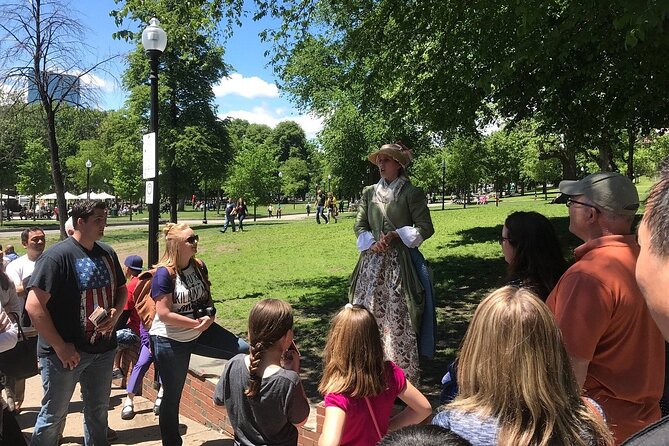
A Freedom Trail walk is interesting because it turns Boston into a readable story. This tour runs on a steady loop of landmark after landmark, with a guide in costume who ties the streets to the Revolution and the early republic. I especially like the in-character storytelling you can hear clearly, and guides such as Ben and Elizabeth have been singled out for making history flow from stop to stop. One consideration, though: the route passes through busy, popular areas, so if you are sensitive to crowds and noise, plan to listen closely and keep your group together.
The second thing I like is how practical the tour feels for first-timers. You get a tight 1.2 mile (about 2 km) route, about 1 hour 45 minutes, and most stops are free to enter. A possible drawback is that humor and character work can be hit-or-miss depending on the guide, so if you want a strictly academic tone the whole time, you may prefer a tour that leans less theatrical.
Key highlights worth planning around
- Costumed guide storytelling that links each site to the Revolutionary-era themes you care about
- Prime stop mix including Park Street Church, Granary Burying Ground, King’s Chapel, and Faneuil Hall
- Founding Father focus with Franklin and the Boston Tea Party discussed on the route
- Most stops are free to enter, so your $26 goes further than many paid attractions
- Small enough to manage with a maximum of 50 people, but still expect crowds at famous corners
- Designed for real walking at about 1.2 miles, a pace most travelers can handle
A 1.2 mile Freedom Trail walk with a costumed guide, not a long museum day
This tour is built for people who want the Freedom Trail experience without committing to a half-day or getting stuck in indoor lines. You cover about 1.2 miles (2 km), roughly 1 hour 45 minutes, and you are moving most of the time. That means you still get to enjoy Boston street life, not just stare at placards.
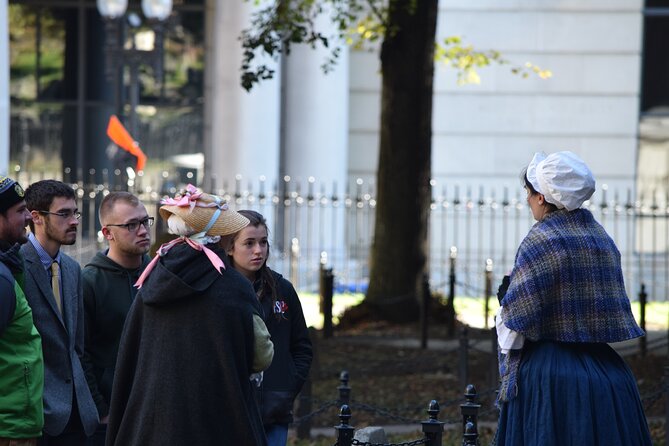
The biggest value is the guide. You are not just collecting facts, you are getting the story told in a way that makes the places feel connected. Reviews repeatedly call out guides like Ben and Elizabeth for strong narration and keeping groups engaged even in cold weather. If you do well with oral storytelling, this format works.
More Walking Tours in Boston
- Boston: Freedom Trail History Small Group Walking Tour
★ 5.0 · 6,450 reviews - Cambridge: Harvard University Student-Guided Walking Tour
★ 4.6 · 3,931 reviews - Harvard University Campus Guided Walking Tour
★ 4.5 · 3,632 reviews
Starting at the Massachusetts State House, then Park Street Church for a song’s origin
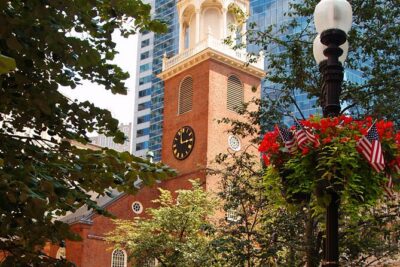
You begin at the Current Massachusetts State House, a natural starting point because it frames Boston history in the place where power and government still show up daily. From there, you head to Park Street Church, which matters because it is tied to the first performance of My Country ’Tis of Thee. That alone is a smart anchor for the tour, since it shows how public feeling and politics traveled through music, not just speeches and documents.
Park Street Church is also one of the easy stops in terms of time, about 5 minutes, and the entry is free. That makes it a good moment to regroup, check directions for where you will be heading next, and settle your listening position before the rest of the walk gets more crowded.
Practical tip: stand where you can see the guide’s face and posture. In dense meeting points, listening gets harder if you trail behind.
Park Street to Granary Burying Ground: where Boston writes its own footnotes

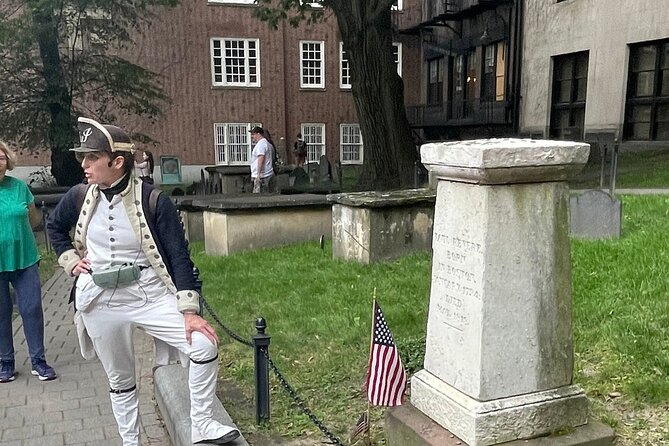
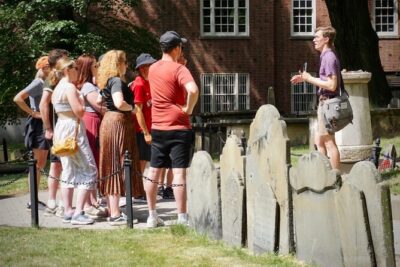
Next is Granary Burying Ground, one of those stops that makes the names on a textbook feel real. The tour takes about 20 minutes here, and the guide focuses on Founding Fathers and what their final resting place symbolizes. This is the stop that tends to produce the biggest split in opinions: some people love the slower pacing and atmosphere, while others would rather keep moving.
There is a real reason they slow down. Cemeteries force you to notice detail. Dates, symbolism, and the setting turn a biography into something more human. If you are the kind of traveler who enjoys time to look around, Granary is a highlight.
If you are not, bring patience. This is also the part of the tour where you may feel the tightest crowding because other groups often linger in the same area. Keep an eye on where your group is headed so you do not get left behind in the shuffle.
King’s Chapel and the oldest English burial ground detail that changes how you see the neighborhood
After Granary, you move to King’s Chapel, described on this route as America’s first Anglican church. That detail matters because it captures Boston’s early religious mix, not just its political drama. The stop is brief, about 5 minutes, and it is free.
Right around there, the tour also points you toward Boston’s oldest English burial ground. The theme is simple but powerful: Boston’s colonial era is not only in buildings you can photograph. It is in who lived here, where they were laid to rest, and how long the city has been shaping its own identity.
More of the Freedom Trail:
- Boston Freedom Trail Walking Tour with Costumed Guide
★ 4.5 · 2,531 reviews - Boston Food & History: Pizza, North End & Freedom Trail
★ 5.0 · 1,772 reviews - Boston’s Freedom Trail: A Revolutionary Walking Tour
★ 4.9 · 1,748 reviews - Boston’s Freedom Trail: A Revolutionary Walking Tour
★ 5.0 · 1,343 reviews
Boston Latin School and Franklin: the public school and the alumnus connection

A huge portion of American history can sound like it belongs to famous men alone. This tour helps rebalance that by taking you to Boston Latin School, often described as America’s first public school. You will spend about 5 minutes here, and the entry is free.
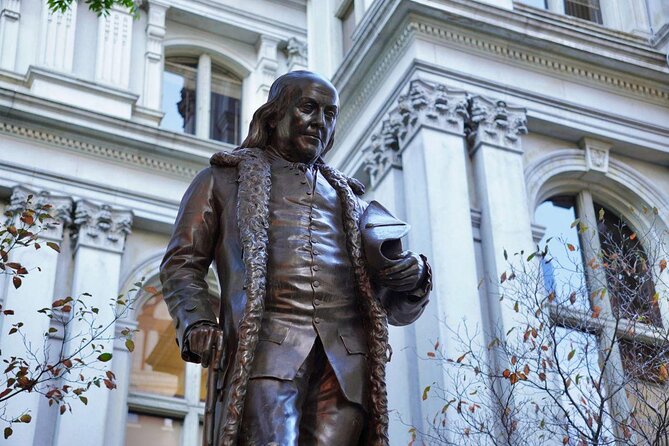
Then comes Benjamin Franklin’s statue, also about 5 minutes. The guide ties Franklin directly to Boston Latin School, emphasizing how the school shaped one of the most influential figures of the founding era. I like this because it gives you a cause-and-effect feeling. Education is not background. It is part of how the Revolution gathered momentum.
If you have kids or teenagers, this portion can land well because it turns history into something that looks like a real-life path, school to civic life. One review even specifically praised a guide who worked well with younger kids and kept them attentive the whole time.
Old Corner Bookstore: the publication story you actually remember
Next is the Old Corner Bookstore, described here as America’s oldest commercial building. This stop is short, about 5 minutes, and free to see. The story tied to the building is the publication of the Midnight Ride of Paul Revere.
That is smart storytelling, because it connects a landmark to something tangible you can picture, a message moving from press to public. Instead of treating Paul Revere as only a dramatic figure, you see him as part of an information system, where printing helped ideas spread.
This is also a good stop to use as a breather. With a short pause, you can scan for how your next intersection might look and keep your feet comfortable for the remaining walk.
Old South Meeting House and the Boston Tea Party moment

Now you get to the Old South Meeting House, a 10 minute stop on the route tied to the Boston Tea Party. Here is the key logistics point: entry is not included, so you will need to decide whether you want to go in. Even if you stay outside, the guide’s story usually gives you context to make the exterior meaningful.
This stop is valuable because it shifts you from founding personalities to collective action. The Tea Party is not only about ships and taxes. It is about coordination, fear, timing, and public messaging.
Crowd note: Old South and nearby streets can be packed, especially during peak hours. A guide who can keep the group moving efficiently is worth more than any extra signage. Reviews praise several guides for staying easy to hear even in crowded conditions.
The oldest standing government building stop: where power becomes physical
At the next point, the tour includes the oldest standing government building in Boston. Even without going deep into architecture details, this is a strong moment because it makes government feel physical. You are not just hearing about leadership. You are looking at a long-lasting structure tied to civic authority.
Time on this segment is not listed as a separate number in the details I received, so expect it to be part of the flow between major set pieces rather than a huge standalone detour. The practical win is that you keep the walk cohesive.
Boston Massacre site and the protest that turned into a battle cry
Then you reach the Boston Massacre Site, another 10 minute stop with a strong narrative payoff. The tour focuses on the massacre and how the protest sentiment turned into a battle cry throughout the Revolutionary War.
This stop works best if you let the guide set the tone before you start reading everything around you. The words you hear help you interpret what you see. Without that framing, you can end up with a pile of plaques and no clear takeaway.
There is also mention of a tale of Sam Adams on the route. That connection matters because it brings the story back to the people who helped shape public anger into organized resistance.
Faneuil Hall Marketplace: the iconic wrap-up where history meets everyday Boston
Your final major stop is Faneuil Hall Marketplace, described as the most iconic historical attraction in Boston. This is about a 5 minute stop on the tour details provided, and it is free to see.
Even if you have been to Boston before, Faneuil Hall tends to do something useful for your memory. It gives you a central place where the Revolution themes do not disappear into side streets. After you hear about meetings, protests, and public speech, the marketplace setting helps the story feel grounded in daily life.
If you want to keep exploring after the tour, this is a great place to pause. It is also a good point to ask questions, because you are in a more open, recognizable area where your group can regroup.
Pace and comfort: what to do with 50 people and winter cold
This tour caps at 50 travelers, which is big enough to be lively but small enough that you should be able to track your guide. Still, expect crowds at key stops. Several reviews mention the sidewalks can get crowded, yet the guide can be heard, as long as you stand close and face forward.
Because you are walking roughly 1.2 miles, comfort matters more than athletic ability. Wear supportive shoes. The route is not described as difficult, and one review explicitly notes the walk is not too hard, but Boston footwear failures are real.
Weather matters too. The tour runs in all weather conditions, and you are told to dress appropriately. Reviews include cold-weather praise for guides who kept energy up even when everyone was bundled. If it is windy, bring a hat and something that covers your ears so you can keep hearing the story at every stop.
One more practical move: keep your phone charged. The tour uses a mobile ticket, so you will want it ready without wrestling for battery at your first stop.
What $26 buys: short walk, mostly free stops, and a guide who strings it together
At $26 per person, this is priced like a value-focused walking tour. The reason it feels like a good deal is the way the stop mix works. Most stops listed are free to enter, and the paid-ticket element is minimal, with Old South Meeting House called out as not included.
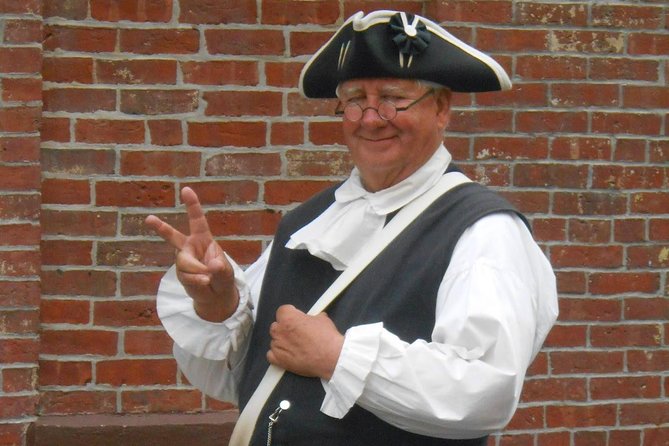
What you are really paying for is the guide’s job: connecting the dots so the names and places do not stay trapped in separate facts. Reviews strongly favor guides who do exactly that. People highlight guides who stay in costume, keep stories flowing, and handle questions without losing the group’s momentum.
Could it feel too talky? Yes, there is at least one comment about too much talking and not enough walking, and another about time spent in the Burying Ground. That is the trade-off with a story-heavy walking tour. If you like absorbing details, you will probably love the pacing. If you want constant motion and minimal narrative, you might not.
Who should book this Freedom Trail Walking Tour 250
This tour is a great fit if you want:
- A first sweep of Freedom Trail sites in a compact time window
- A guide who adds personality and story, not just dates
- Founding-era connections that link music, print, schools, and protests
It is also a solid choice for mixed ages. Reviews call it fun for teens and grandparents, and multiple people mention guides doing well with kids. The in-character approach often helps younger travelers focus.
You might think twice if:
- You want strictly academic history, with minimal humor
- You strongly dislike hearing names in character voices or jokes
- You have limited patience for a longer cemetery segment
And if you are a guide-fan type, pay attention to the guide names that people recommend most, like Ben, Elizabeth, Elaina, Catherine, Mark, and even characters people requested like Elaina Jacobs or Catherine the Great. That suggests some guides bring a style that really clicks.
Should you book it? My decision guide
Book this tour if you want a guided Freedom Trail experience that keeps your day moving, covers the main set pieces, and gives you a clear narrative thread. The price feels reasonable because so many stops are free, and the format is built for hearing the story on the sidewalks, not reading it later.
Skip or consider alternatives if you are very sensitive to crowds or to guide humor that may not match your taste. Also think about how you feel about spending time in a cemetery. If that is a deal-breaker for you, you will want a tour that spends less time there.
Bottom line: for most people, this is a strong way to get oriented fast and understand why these Boston sites matter, without turning the trip into an all-day history seminar.
FAQ
How long is the Freedom Trail Walking Tour 250?
It runs about 1 hour 45 minutes.
How far do we walk?
The tour covers approximately 1.2 miles (about 2 kilometers).
What language is the tour offered in?
The tour is offered in English.
Do I need to buy tickets for the stops?
Many stops are listed as free to enter. Old South Meeting House is noted as admission not included.
Are there multiple start times?
Yes, there are a few start times available to fit your schedule.
Is the ticket delivered on a phone?
Yes, it uses a mobile ticket.
Does the tour run in bad weather?
It operates in all weather conditions, and you are asked to dress appropriately. If it is canceled due to poor weather, you are offered a different date or a full refund.
Is it suitable for people with mobility needs, and are service animals allowed?
Most travelers can participate. Service animals are allowed, and the tour is near public transportation.
Reviewed most recently around Boston
- City Cruises Salem High Speed Ferry to/from Boston★ 4.5 · 727 reviews
- Entire Freedom Trail Walking Tour: Includes Bunker Hill and USS Constitution★ 5.0 · 732 reviews
- Boston Freedom Trail History Pub Crawl Small-Group Tour★ 5.0 · 996 reviews
- Delicious Donuts of Boston: A Sweet History Walking Tour★ 5.0 · 1,038 reviews
- Boston Pizza Lovers Food and History Walking Food Tour★ 4.5 · 1,082 reviews
- Boston’s North End Food Tour: Italian Flavors & Heritage Walk★ 5.0 · 1,322 reviews
- Boston’s Freedom Trail: A Revolutionary Walking Tour★ 5.0 · 1,343 reviews
- Boston North End Food Tour of 6+ Tastings, Cannoli, Lobster Roll★ 5.0 · 1,404 reviews
Freedom Trail Tours, compared.
Freedom Trail History Small Group Walking Tour
Read our review →
Boston Freedom Trail Walking Tour with Costumed Guide
Read our review →
Boston Food & History: Pizza, North End & Freedom Trail
Read our review →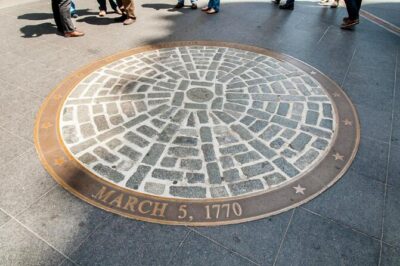
Boston’s Freedom Trail: A Revolutionary Walking Tour
Read our review →
Boston Freedom Trail History Pub Crawl Small-Group Tour
Read our review →
Entire Freedom Trail Walking Tour: Includes Bunker Hill and USS Constitution
Read our review →
Browse the lists this tour appears in