
Reviewed · WALKING TOURS
Heart of Savannah History Walking Tour – 2hr
Savannah works best when you can see the clues in front of you. This 2-hour walking tour turns the famous squares into a simple timeline, with American Revolution and Civil War stories, plus a pop-culture stop you will instantly recognize. I love how the guide connects the city’s street plan to why the colony was founded where it was, and I love the mix of big landmarks with smaller, more specific details like fingerprints in the brick at the Sorrel Weed House. One consideration: it is a steady walk, so comfortable shoes matter, and about a mile is on your feet.
You will also get a clear route end to end, starting at Wright Square in the historic district and finishing at the Forsyth Park Fountain. Guides such as Rick Moss, Crystal, Mark, and Rose are frequently praised for being funny and for keeping the stories moving, so even if history is not your main hobby, you should still enjoy the pacing and the surprises.
Key highlights you will feel right away

- Wright Square orientation with Savannah’s original layout, the 40-foot bluff, and Tomochichi tied to the Gordon Monument
- Chippewa Square Forrest Gump moment plus a quick correction that Savannah’s central monument is about James Oglethorpe
- Revolution to Civil War thread through places connected to the Siege of Savannah and Sherman’s March to the Sea
- Architecture stops that explain why it looks different including Gothic Green-Meldrim House and its 1850s price tag
- Lunch or tea idea baked into the route at the Gryphon Tea Room in the Shriner’s Building
- Forsyth Park finish with a fountain story you can’t un-know once you hear it
Entering Savannah’s timeline at Wright Square
Your tour starts at the north side of Wright Square, in front of the Gordon Monument. This is a smart opening because Wright Square is not just a pretty square, it is where Savannah’s founding logic becomes obvious. The guide explains why General James Oglethorpe chose a site on a 40-foot bluff, and you also learn what makes the squares work as a city design. If you have ever wondered how Savannah got so orderly, this is where it clicks.
You also get a few facts that change how you read the monument itself. The tour ties in Tomochichi, the chief of the Yamacraw Indians, and you are told how his story connects to the Gordon Monument. I like that the guide does not treat history as a list of dates. It is more like, here is why this place was picked, here is what the city needed, and here is what you are standing on.
One practical perk here: you begin with a set of big-picture ideas, so the rest of the walk feels less random. You are also starting near good photo angles before the route pulls you deeper into the historic district.
More Historical Tours in Savannah
- Savannah History and Haunts Candlelit Ghost Walking Tour
★ 5.0 · 3,235 reviews - Historic Savannah Guided Walking Tour
★ 5.0 · 2,918 reviews - Narrated Historic Savannah Sightseeing Trolley Tour
★ 4.5 · 2,375 reviews
Juliette Gordon Low Birthplace: outside views still tell the story
Next up is the Juliette Gordon Low Birthplace Museum. You will admire the birthplace of Juliette Gordon Low, born October 31, 1860, founder of the Girl Scouts. The tour includes the key context about the Gordon family and what the site is used for today.
The catch is simple and helpful: you do not go into the home. You view it from the outside and keep moving. For many people, that is a plus because it keeps the tour at a brisk, easy pace. If you are the type who loves entry tickets and interior rooms, you might wish for more inside time, but the tour is designed as a walking orientation through the city rather than a museum day.
Independent Presbyterian Church: where fires, hurricanes, and faith changed the building
At the Independent Presbyterian Church, you get another layer to Savannah’s story: how places get rebuilt, not just admired. The guide explains the church’s early location on Ellis Square, originally Market Square, then the fact it was destroyed by fire. It was rebuilt on Telfair Square and later destroyed by a hurricane, and today it sits at Bull St and Oglethorpe Ave where it was built in 1855.
This stop also turns into a fun history puzzle. You learn which US President was married in the church in 1885, and why the steeple is famous today. Even if you are not usually drawn to churches, I think this stop is worth it because it shows how Savannah keeps reinventing itself after disasters.
Chippewa Square and the Forrest Gump waiting spot
Chippewa Square is the tour’s most pop-culture recognizable moment. The guide points out the place where Forrest Gump sat with his box of chocolates while waiting for the bus. If you came to Savannah hoping for at least one easy win, this is it.
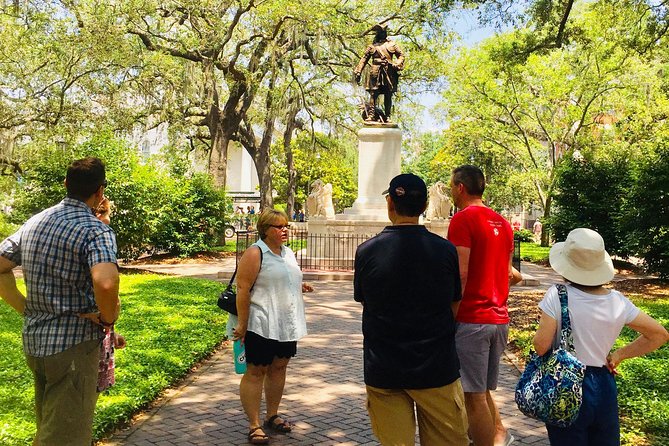
But the guide also uses this stop to teach you how monuments can get mistaken. In the center of Chippewa Square, the monument is General James Oglethorpe, not Captain Morgan. The tour plays with the mix-up in a light, practical way, and it is a good reminder to look closely at what you are seeing rather than relying on memory or movie logic.
From a value standpoint, you get both: a fun photo moment and a meaningful reorientation to the city’s founder and what his monument represents. It is also a good break in the route, because everyone pauses here and you can regroup before the next set of stops.
More Walking Tours in Savannah
- Savannah First Squares Culinary & Cultural Walking Food Tour
★ 5.0 · 3,229 reviews - Southern Flavors Food, Pub Crawl, and History Walking Tour
★ 4.5 · 1,623 reviews - Genteel and Bard’s Savannah Dark History and Ghost Encounter Walking Tour
★ 5.0 · 1,546 reviews - Bonaventure Cemetery Walking Tour with Transportation
★ 5.0 · 1,467 reviews
Sorrel Weed House, Madison Square, and the darker threads of Savannah
After Chippewa Square, the route shifts toward the spooky and the serious.
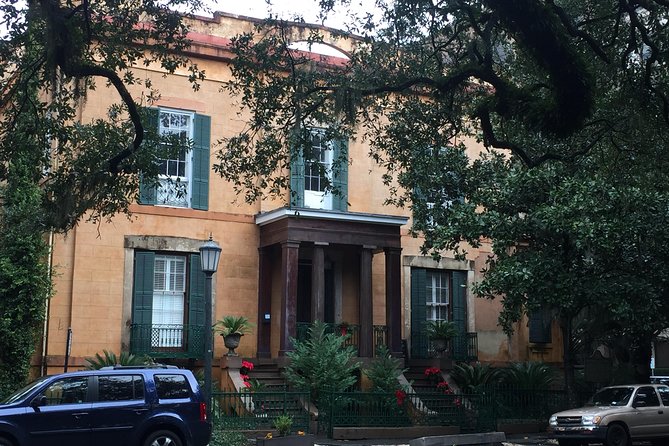
At the Old Sorrel Weed House Museum & Tours, you pass by one of Savannah’s most haunted homes. You will not spend time inside here, but you still get the kind of detail that makes a walk feel more like a guided story. The guide talks about the Savannah gray brick wall surrounding the courtyard and why there are fingerprints in the brick. You also hear the question the stop raises, where did the brick come from. Even if you are not buying into ghost stories, the architecture and the building practices are the kind of detail that make Savannah feel different from other Southern cities.
Then comes Madison Square, where the tour connects the current park space to one of the American Revolution’s bloodiest battles: the Siege of Savannah. This is one of those stops that reminds you that the squares you relax in had serious stakes. It helps you understand why Savannah is so full of monuments, not because the city loves itself, but because so many chapters were hard.
Green-Meldrim House: Gothic style with real dollar signs
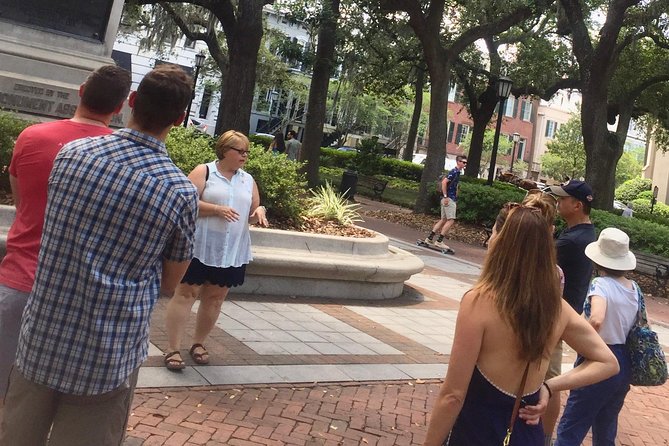
Green-Meldrim House is where the tour leans into architecture. The home was completed in 1853 and is described as one of the finest examples of Gothic Architecture in the South. The guide also gives you context on cost, including how it set a high bar for its time, at $93,000 then, or about $3.2 million today.
What I like here is the way the tour connects style to status. You can see the look, but the price explanation helps you understand why people cared about building this way. This stop also ties the home to the Civil War, since it served as headquarters for General Sherman during his March to the Sea when he occupied Savannah.
So in one location you get: design, money, and military relevance. That is a rare, efficient combo on a walking tour.
SCAD and the Shriner’s Building: two stops that explain how buildings get new lives
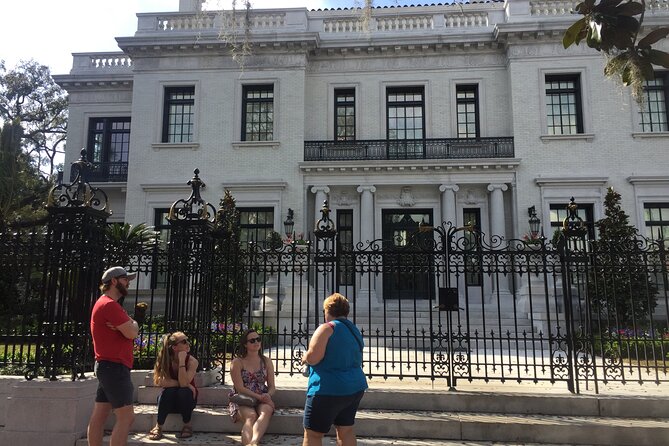
After Green-Meldrim, you pass by a Savannah Volunteer Guard building that was originally built for that purpose, and is now owned by SCAD. You do not get an interior tour here, but you get enough context to recognize how the city reuses old structures.
Then you reach the Shriner’s Building, home to the Gryphon Tea Room. This is one of the stops that feels practical even if you are on a tight schedule. The guide explains that inside the Gryphon Tea Room is a museum in itself, once used as Solomon’s Apothecary. You will see the original mahogany cabinetry and cubbies used to store medicines.
I like that the tour does not just point and move on. The guide’s tone suggests you should consider this place as a real option for a sit-down break, whether you want lunch, dinner, or just a cup of tea. The tour keeps you outdoors during most of the walking, so having a clear place to pause later is genuinely useful.
Midnight in the Garden of Good and Evil: the Jim Williams house stop
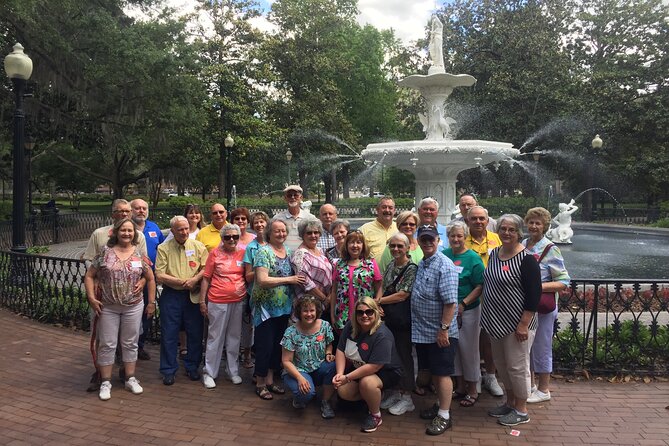
Savannah has a talent for making its history feel current, and this stop is a big part of that.
The tour covers the Mercer Williams house, made famous by the book Midnight in the Garden of Good and Evil by John Berendt. You hear about Jim Williams, who bought the home in 1969, and the shooting of his assistant Danny in 1981. The book came out in 1993 and became a New York best seller for 216 weeks, then the movie release helped put Savannah on the tourism map.
This is also where you get a helpful personal tip. The guide recommends reading the book or at least watching the movie before you visit Savannah, because you will recognize stories faster and you will understand what people mean when they talk about the house.
Armstrong-Kessler house: the wow-factor private home you see from outside
Next is Armstrong House, now known as the Armstrong-Kessler house. The guide talks about the history of the home and who lives there today. You also get a sense of scale, since it is described as a 26,000+ square foot property.
This is one of the stops that earns its reputation for visual impact. It is framed as the one home in town where people stop and gasp, because it looks impressive even from a distance. The tour does not include interior access, and the home is private. If you come expecting a full tour of the interior, you may be a bit disappointed, but the value here is that you still get the context without needing extra tickets.
Forsyth Park finale: fountain photos and what makes the park special
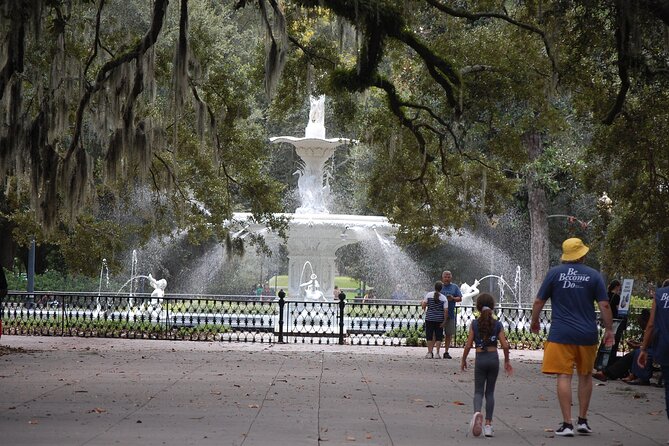
You end at Forsyth Park, specifically at the fountain. The tour explains that the park began in 1848 with only 10 acres, and it now covers 30 acres. The guide frames it as Savannah’s Central Park, a place enjoyed by young and old alike.
Then you hit the crowning jewel. The Forsyth Park Fountain is treated like the obvious photo, but the tour adds the detail most people miss: it was a catalog mail order from France, installed in 1858. Once you hear that, the fountain feels less like a random landmark and more like part of a global story about how cities wanted to look.
This final stop is also a practical wind-down. It gives you a clear destination, and benches and open space help you reset after the walking.
How long you walk, what to bring, and when to go
The walking distance is described as about one mile, with benches along the way. That makes this a good choice for most people who can handle a couple hours of easy city pacing.
Still, plan for weather. The tour operates rain or shine, and in hot summers Savannah can be hot and humid, so bring water. An umbrella is a smart idea if you think rain might pop up. Comfortable walking shoes are the big non-negotiable. It is a historic district, so the ground can feel uneven in spots, and you will be happier if your feet are supported.
You also get a choice of morning or afternoon tour time. If you are sensitive to heat, the morning can feel easier. If you want softer light for photos, afternoon may fit your schedule better.
Value check: what you pay for when most stops are outside
Most stops on this tour are designed for outside viewing. That matters for value because you are not spending your time and money on lots of separate entry fees. The itinerary notes free admission for the key sightseeing stops, and Armstrong-Kessler House is not open for tours and is marked as admission not included.
So the tour price is really buying something you cannot pick up on your own quickly: a guided route through Savannah’s squares, with stories that connect the design and the events. The guide also helps you spot what you might otherwise overlook, like why a monument is placed where it is, and how one building connects to another era.
If you like a tour that functions as orientation plus a few story-driven rabbit holes, this fits. If you want hands-on museums every stop, you might feel like you are mostly viewing from the sidewalk, at least for the main set of stops.
Who this walking tour is best for
This is a strong match if you are:
- In Savannah for a short time and want a fast sense of the historic district
- Interested in how the city’s plan relates to the founder, Oglethorpe, and the colony’s choices
- Excited by the mix of American Revolution sites and Civil War context
- At least mildly into Savannah pop culture, because the Forrest Gump and Midnight in the Garden of Good and Evil stops are central to the route
It is less ideal if you want long indoor stops, because the experience keeps you moving and most sites are seen from outside.
Should you book the Heart of Savannah History Walking Tour?
If you want a guided way to understand Savannah’s squares and the people behind them, I think you should book this. The route lands you at the places that shape your first impression, and you finish at Forsyth Park with photos and a fountain story you will remember.
I would only think twice if you are sensitive to walking time, or if you strongly prefer museums and interiors over outdoor landmark viewing. For most people, the mix of founding details, Revolution and Civil War connections, and movie-ready stops makes the 2 hours feel like a smart use of your day.
FAQ
How long is the Heart of Savannah History Walking Tour?
It is approximately 2 hours.
Where does the tour start and end?
It starts at Wright Square in Savannah, GA and ends at Forsyth Park. The tour ends at the Fountain in Forsyth Park.
Does the tour go into buildings or homes?
The tour notes that you do not go into the Juliette Gordon Low Birthplace home. Other stops are described as passing by or admiring from the outside.
Is Armstrong House open for tours during this experience?
No. Armstrong House, also known as the Armstrong-Kessler house, is a private home and is not open for tours. Admission there is not included.
Does the tour run in the rain?
Yes, the tour operates rain or shine. If severe weather happens, you may be offered an option to reschedule. If the experience is canceled due to poor weather, you are offered a different date or a full refund.
How far do we walk, and what should I bring?
You should plan for about 1 mile of walking, with benches along the way. Comfortable walking shoes are recommended, and in warm weather you should bring water. An umbrella is also a good idea since the tour can run in rain. Service animals are allowed.
Reviewed most recently around Savannah
- 2 HR Savannah Riverboat Dinner Cruise with Onboard Entertainment★ 4.0 · 794 reviews
- Bonaventure Cemetery & Wormsloe State Historic Site Tour★ 5.0 · 805 reviews
- Bonaventure Cemetery Scenic History Art Symbols and Film Tour★ 5.0 · 870 reviews
- Savannah: Old Savannah Tours Historic Overview★ 4.6 · 874 reviews
- 2-Hour Explore Savannah Bike Tour★ 5.0 · 970 reviews
- Spooky Savannah Haunted Pub Crawl★ 4.5 · 986 reviews
- True Crime Pub Crawl – the Original Savannah Murder Tour★ 5.0 · 1,053 reviews
- Sixth Sense Savannah Ghost Tour★ 4.5 · 1,148 reviews
Walking Tours, compared.
History and Hauntings of Salem Guided Walking Tour
Read our review →
New Orleans Premier Ghost, Voodoo and Vampire Walking Tour
Read our review →
Freedom Trail History Small Group Walking Tour
Read our review →
Historic Charleston Guided Sightseeing Walking Tour
Read our review →
New Orleans Food Walking Tour of the French Quarter with Small-Group Option
Read our review →
St. Louis Cemetery No. 1 Official Walking Tour
Read our review →Browse the lists this tour appears in