
Reviewed · AUSTIN TOURS
Double Decker Austin Single Loop Sightseeing Tour
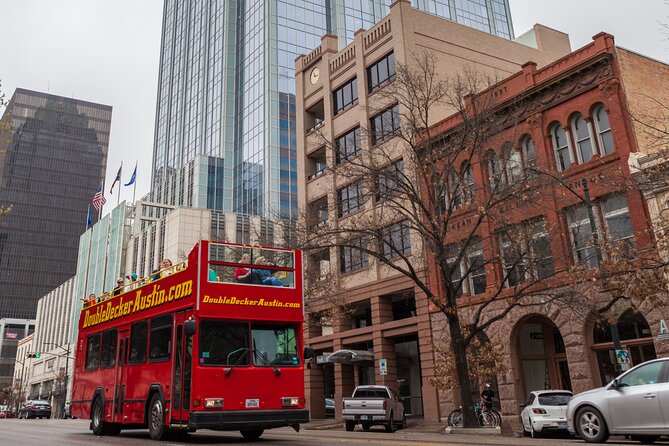
Austin’s downtown can feel like a lot all at once, so this double-decker loop is a smart shortcut. You get a fast orientation through the city’s top landmarks, with live guide commentary and the choice of an open-air upper deck or a calmer lower deck.
I also like how this tour mixes big-picture Austin with very specific stops, like the Texas State Capitol area, the Governor’s Mansion, and the Central Fire Station site connected to the Austin Fire Museum. One drawback to consider is that the route is built for a short downtown loop, so if you want deep dives into a neighborhood like west Austin, you may feel you only get a “pass by,” not a full exploration.
Key things to know before you board

- Two-deck viewing with open-air top deck for photos, plus a climate-controlled lower deck for comfort
- Live narration as you ride, so you are not stuck reading plaques at every stop
- A tight downtown loop that covers major sites in about 75 to 90 minutes
- Austin Fire Museum and historic house stops add real local context, not just landmarks
- Congress Avenue bats are included in the lineup, and timing matters seasonally
- Small group feel with a maximum of 35 travelers on the bus
Austin Visitor Center start: where to meet your double-decker
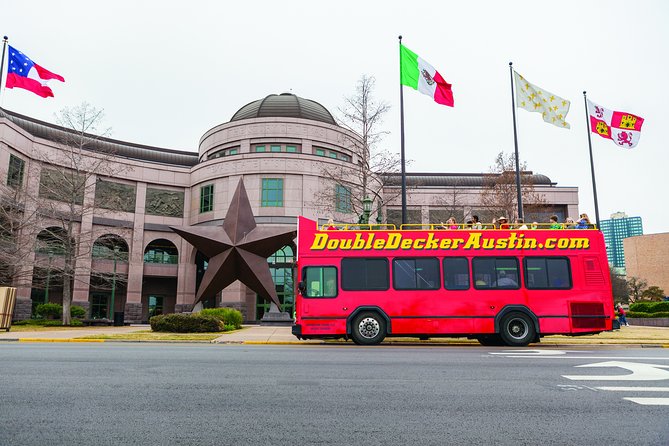
This tour kicks off at the Austin Visitor Center area on 103 E 5th St, right by Red River Street between 4th and 5th. Plan to arrive early enough to find the correct bus and get seated without rushing.
Why that matters: you spend less time figuring it out and more time enjoying the ride. The Visitor Center area is also a convenient place to grab a coffee or a souvenir before you go, and it is an easy place to reset after your loop back.
Expect a smooth flow. The tour is designed around a quick on-and-off rhythm, and you will typically want to be ready to load when your departure time is called.
Stack these Austin options against each other
- Best of Austin Small-Group Driving Tour with Local Guide
★ 5.0 · 2,275 reviews - Austin Biker Gang E-Bike Tour
★ 5.0 · 1,399 reviews - Austin Food Tour with Local Flavors, Tacos & 6 Food Tastings
★ 5.0 · 987 reviews
Two-deck comfort: top deck views vs lower deck calm
The big reason to pick a double-decker is choice. From the open-air top deck, you can get great sightlines for downtown photos. You also feel the breeze, which can be a win when the weather is mild.
From the climate-controlled lower deck, you trade the outside view for more comfort, especially if it is hot, windy, or you just want a more relaxed ride. The lower deck can also be easier if you are traveling with kids or anyone who prefers a steadier seat.
One practical heads-up: the city’s trees and street corridors can be tight. On the upper deck, you may need to duck occasionally to avoid low branches. You can usually manage it with good timing, but it is not the kind of ride where you can forget you are under real trees.
Price and timing: is $36.81 worth 75 to 90 minutes?
At $36.81 per person, you are paying for speed and interpretation. You are not trying to “do everything” on foot. In about 1 hour 15 minutes to 1 hour 30 minutes, you get a guided circuit that helps you understand where everything is and what is worth a return visit.
That value is strongest if:
- You are short on time and want a first-day overview
- You prefer hearing the story while you sit down
- You want a clear sense of Austin geography, from Capitol area to South Congress
It is less strong if you are hoping for a slow, stop-and-stay tour. This is a ride with a route. Some stops are visually emphasized from the bus, and the experience is built around the loop format.
If you are booking ahead, a common pattern is that people reserve about a week ahead. If your travel dates are tight, booking earlier can help you avoid last-minute seat stress.
The Austin downtown loop: 6th Street, Convention Center, and the city core
The loop is centered on downtown, which is good because downtown is where Austin’s “greatest hits” cluster. The route begins by taking you through major central zones and landmarks, with live commentary guiding your attention.
You’ll pass by the Historic 6th Street Entertainment District, which is one of the most recognizable stretches in Austin. Even if you do not plan to bar-hop, it helps to see it early so you understand the scale and the vibe.
You also get the Austin Convention Center area in the mix. That is useful if you are catching an event later or just want to understand where the big conference activity fits into the downtown grid.
The core value here is orientation. By the time you reach the Capitol area and the other headline sites, you are not seeing them as random points on a map. You can start to connect them as part of one compact downtown story.
Another Austin day, played differently:
- From Austin: Hill Country BBQ & Wine Shuttle
★ 5.0 · 954 reviews - Austin and Hill Country Sightseeing Tour
★ 4.5 · 928 reviews - Haunted Austin Walking History Tour
★ 4.5 · 921 reviews - Austin Electric Bike Tour: Let it Ride
★ 5.0 · 892 reviews
Capitol area highlights: Driskill, Texas State Capitol, and the Governor’s Mansion
One of the most rewarding parts of the ride is how the tour frames Austin’s political and architectural landmarks.
You’ll see the Driskill Hotel, a Romanesque-style icon completed in 1886 and known as the oldest operating hotel in Austin. The Driskill is the kind of building that looks better in motion, because you absorb it as part of the streetscape instead of as a single photo target.
Then comes the Texas Capitol area. The Texas State Capitol is widely recognized as one of the nation’s distinguished state capitols, and it is also listed on the National Register of Historic Places (1970) and designated as a National Historic Landmark (1986). Even if you already know the name, the bus ride gives you the “what to look for” context so you notice more when you return later.
The loop also includes the Texas Governor’s Mansion, which has served as the official residence of Texas governors since 1856. There is a known restoration story here, linked to damage from arson in 2008. The way the ride introduces it helps you see it not just as a building, but as part of modern Texas civic life.
Historic sites beyond the postcards: Fire Museum, Hannig home, and William Sydney Porter
Not every bus tour goes beyond landmark signage. This one adds a few history-rich stops that help you understand Austin as a real place, not just a photo list.
You’ll start with the Austin Fire Museum connection at the Central Fire Station No. 1. The museum is tied to uniforms, photographs, and memorabilia spanning the 19th to 21st centuries. That gives you a different angle on city history, one rooted in public service and daily life rather than just politics and architecture.
Then there is the Joseph and Susanna Dickinson Hannig home connection. Joseph Hannig built the home in 1869 for his new wife, Susanna, who survived the Battle of the Alamo and carried news of its fall to Sam Houston. That chain of events matters because it ties Austin to the larger independence story that shaped Texas.
Finally, you’ll get a look at William Sydney Porter’s life in Austin. The tour description explicitly points you toward the inside, so this is the kind of stop that can add texture beyond the street-level views.
The upside of adding these spots: you come away with a sense of Austin’s layers. The potential downside: if you are expecting a long time at each site, you may find the timing is tight. This is still a loop tour, so treat these stops as highlighted context, not a full museum day.
LBJ Library to UT Tower: Texas big ideas, sports stadium, and campus landmarks

After the Capitol area, the tour shifts into the “Texas influence” lane: presidents, museums, education, and major institutions.
You pass by the Lyndon Baines Johnson Library and Museum. Even if you have heard of it, it helps to see how the tour frames what you will find there: facts and complexity, not just triumphs. That kind of framing can change how you experience a museum later.
Next up is the Darrell K Royal-Texas Memorial Stadium on the University of Texas campus. The stadium has been home to the Longhorns since 1924, and the description includes a historical note about capacity and scale before later stadium seating changes. If you are a sports fan, this is the part where the city’s energy feels most obvious.
Then you will see the 307-foot tall UT Austin Tower, completed in 1937, which serves as a landmark and symbol of academic opportunity.
What makes this section work is pacing. You are moving from civics to culture to campus identity. You start to understand that in Austin, the university is not a separate world. It is part of the city’s everyday storyline.
Museums from the bus: Bullock, Blanton, and the Ransom Center
This tour also includes a lineup of museums tied to Texas storytelling and art.
You’ll pass by the Bullock Texas State History Museum, opened in 2001 as the official history museum of the State of Texas. The tour messaging emphasizes interpreting the continually unfolding story of Texas through educational experiences, which is a good signal if you like museums that teach rather than just display.
You will also see the Blanton Museum of Art. The collection is described as including more than 19,000 works, reaching from ancient Greek pottery to abstract expressionism. Even from the bus, it helps to understand where it is located if you want to plan an art stop later.
Finally, the tour includes the Ransom Center, described as a research center focused on humanities tied to writers and artists. It is a good choice for people who like the idea behind museums, not just the surface-level highlights.
This museum cluster is a win if you want an “Austin culture map” without spending your whole day ticket-hunting and route-planning.
Congress Avenue Bridge bats and South Congress: a taste of Austin nights
One of the most “Austin” moments on the loop is the Congress Avenue Bridge, famous for sheltering the largest urban bat colony in North America. The description includes the typical range of 750,000 to 1.5 million bats flying out near dusk.
If you are traveling during the April to October window, this is a timing note you should take seriously. The bus tour gives you the location and the significance, and that makes it easier to decide if you want to come back for bat viewing on your own.
After that, the route includes South Congress, described as a must-stroll area south of Lady Bird Lake with boutique shops, eateries, galleries, and music venues. Even if you do not shop, seeing the neighborhood from the bus gives you a sense of why locals treat it as a social anchor.
The honest value here: you get a vibe check. Then you can decide whether to turn it into an evening mission.
The Long Center: where the arts meet real Austin
The tour route also includes the Long Center. It is described as hosting performances, music, movies, hangouts, festivals, and other interests that unite and delight. That description matters because it signals the Long Center is not just an arts building. It is a community space with an active calendar.
If you are the kind of traveler who likes to build plans around events, this stop is a useful reminder. You might not know what is on during your exact dates, but seeing the location helps you make an easy call later.
And when you finish the loop back at the Visitor Center, you have a natural next step: pick a neighborhood to revisit. Now you know where to go, and you know why.
Should you book the Double Decker Austin Single Loop Sightseeing Tour?
Book it if:
- You want a first-day orientation so your remaining Austin time is smarter
- You like guided context while you sit down
- You want a route that connects Capitol area landmarks to UT campus and South Congress in one go
Skip it or pick something else if:
- You are hoping for long time at each site, or you need deep museum immersion
- You mainly care about neighborhoods outside the downtown spine
- You prefer a very quiet, very factual tour style, and you tend to dislike playful guide energy
If you do book, my practical advice is simple. Schedule this early in your trip, bring sunscreen if you choose the top deck, and treat it as your map-reading day. The real payoff is not just seeing Austin once. It is using what you learn to decide where to go next.
FAQ
Where does the tour start?
The tour starts at the Austin Visitor Center area at 103 E 5th St, Austin, TX 78701, on the bus route on Red River Street between 4th Street and 5th Street.
How long is the tour?
The duration is about 1 hour 15 minutes to 1 hour 30 minutes.
How much does the tour cost?
It costs $36.81 per person.
Is the tour commentary in English?
Yes, the tour is offered in English.
What ticket format do I get?
You receive a mobile ticket.
Can I choose where I sit on the bus?
Yes. You can sit on the open-air upper deck for views or in the climate-controlled lower deck.
How many people are on the bus?
The maximum group size is 35 travelers.
Is the tour dependent on weather?
Yes. The experience requires good weather. If it is canceled due to poor weather, you will be offered a different date or a full refund.
What is the cancellation refund window?
You can cancel up to 24 hours in advance for a full refund. If you cancel less than 24 hours before the experience starts, you will not receive a refund.
Are service animals allowed?
Yes, service animals are allowed.
Reviewed most recently around Austin
- Austin Electric Bike Tour: Let it Ride★ 5.0 · 892 reviews
- Haunted Austin Walking History Tour★ 4.5 · 921 reviews
- Austin and Hill Country Sightseeing Tour★ 4.5 · 928 reviews
- From Austin: Hill Country BBQ & Wine Shuttle★ 5.0 · 954 reviews
- Best of Austin Small-Group Driving Tour with Local Guide★ 5.0 · 2,275 reviews
- Austin Biker Gang E-Bike Tour★ 5.0 · 1,399 reviews
- Austin Food Tour with Local Flavors, Tacos & 6 Food Tastings★ 5.0 · 987 reviews
Austin Tours, compared.

Best of Austin Small-Group Driving Tour with Local Guide
Read our review →

Austin Food Tour with Local Flavors, Tacos & 6 Food Tastings
Read our review →


Browse the lists this tour appears in